
Just a quick post to let you know that I have started a new Critical Let’s Play video series, this time about Max Payne 3. You can watch the first video, read more about why I am doing this particular game, and (if you want) help support the making of these videos over on my Patreon page.
Some Thoughts on Darius Kazemi’s Jagged Alliance 2 and my own Killing is Harmless
After I released my book Killing is Harmless in 2012, the response was overwhelmingly positive. I’m pretty sure that was mostly just because someone had written a book about a videogame, however, and not due to any inherent quality of the book. That’s not me trying to be modest or putting down my own work (I’m still pretty chuffed that I wrote it), but as some pointed out at the time, probably the most shared piece of information about Killing is Harmless at its release was its word count. It was an exciting book first and foremost simply because it existed, regardless of what it actually said.
Some people, though, wrote some really important and really great scathing reviews of it. Cameron Kunzelman wrote this one, and Darius Kazemi wrote this one. Both Cameron and Darius are good friends and both are incredibly intelligent writers and developers, so I really valued their feedback and critiques of my work. Because, truly, I had no idea what I was doing when I wrote Killing is Harmless. I didn’t even know I was writing a book for most of it! While many took the sheer size of it as a sign of its authoritative stance on what Spec Ops: The Line is ‘about’ (I still cringe every time I see somebody say it is ‘the last word’ on the game, or that there is no need for anyone else to write anything because I’ve already said it), I always intended the book to more modestly be ‘Well, I really enjoyed it and I think this is why’ and also ‘I have no idea how one should even write long-form criticism but let’s try this way and see if that works’. Maybe that just sounds like I am trying to defend myself with retrospective caveats, but Killing is Harmless was always really just an experiment that was taken way more seriously than I anticipated (which, truly, is one of its faults).
So Kazemi wrote his review (which I strongly encourage you to go read before reading this post). Then, this year, he authored his own book about a videogame, Jagged Alliance 2 for Boss Fight Books. It’s a really good book and I highly recommend it! It is also about as different an approach as you could take to analysing a videogame as Killing is Harmless is. Whereas my book was deeply interpretative (something I’ve come to regret; I’ll get to that below) and really just asked the question ‘How did this game allow me to have the engagement with it that I had?’; Jagged Alliance 2 instead asks ‘How is this game a thing? What humans and nonhumans and circumstances and code came together to mediate each other to make this thing into this thing?’. As Daniel Joseph explores in his own post on the book, Bruno Latour’s Aramis is a large influence on this approach that Kazemi takes. Kazemi follows the actors (the creators, the publishers, the other games that came out around the same time, the state of the games industry, how long it would take the code to compile, etc.) to try to understand how Jagged Alliance 2 came to exist as it exists in the time it came to existence.
The other book that Kazemi notes was influential on his own writing is Killing is Harmless. Not methodologically in the way Aramis clearly was, but in a reactive ‘Well if I didn’t like this book about a videogame, how would I write one?’ kind of seed way. That’s very flattering!
In the comments of Kazemi’s review of Killing is Harmless, there’s a conversation between us where I probably fail at not sounding like a slighted, misunderstood artist (you just don’t get it, man). I note in that wall of text about how what interests me about Spec Ops: The Line is how it is such a broken game that shouldn’t even exist. Like, it simply shouldn’t. It’s commercially unfeasible. It’s a game that reflects the anger and frustration of its own development, as I found out months later when I actually spoke to somebody who worked on the game for the first time. As with Jagged Alliance 2, there is a very interesting story to tell about Spec Ops: The Line in regards to ‘How is this even a thing that exists?’. About how (as far as I can tell) 2K really wanted their own military shooter franchise and threw Yager at it and then threw Walt Williams at Yager and then everyone making the game realised they hated this kind of game and all that anger and spite found itself in this beautiful mess of a game. The Aramis analysis of Spec Ops: The Line would have been fascinating. But I didn’t do that. Instead I just spoke about myself and how I felt about the game. Knowing now what I didn’t know about the game’s development then, I see how that approach would’ve been frustrating to read.
Going to go sideways for a minute here and work my way back: through 2013 (the year after I released Killing is Harmless), I read a whole bunch of Susan Sontag’s work. In particular her essays “Against Interpretation” and “On Style” had a dramatic influence on how I think about my own videogame criticism. You can probably find those essays pretty easily but, essentially, Sontag hates metaphor. An artwork, for Sontag, isn’t about X, it is X: a painting isn’t some melancholic ode to loneliness; it is a painting. She insists that the critic has to stop trying to look past the formal properties of an artwork to interpret its ‘content’, and instead talk about how that content (what the artwork is ‘about’) is emergent from its formal properties. Which is true, right? Any themes or meanings or tones or atmosphere of any work of art emerges from how its material, formal properties are arranged (how they are able to be arranged and how they are not able to be arranged). This is no less true for videogames (and really, the whole obsession with immersion and virtual worlds is just an extension of this centuries-long obsession with looking past form to analyse content).
Sontag’s work has strongly challenged my approach to games criticism both academically and, uh, ?journalistically?. It helped me realise my purely ‘textual’ approach was pretty insufficient. Not because you can’t textually analyse a videogame (you can; ‘interactivity’ doesn’t prevent that), but because you can’t ignore the actual, formal, material engagement the player has with a videogame object in videogame play. I think I already accounted for this somewhat in my writing (Killing is Harmless jumps back and forward between the actual and virtual world as easily as our eyeballs do when we play videogames, rather than pretending the virtual world is ever really completely sealed off from the actual), but I don’t think I ever really appreciated talking about the videogame as an object in that engagement. And criticism around other media do this all the time. Film criticism will talk about the certain camera angles or lighting styles or lens/film sizes that allowed certain things to emerge in a certain film; painting criticism will talk about the types of paint and canvas used that evoke a certain tone; music critics will talk about the age of a certain instrument used in a certain performance that gave a certain timbre to the music. We do it a bit in videogames (talking about how the Rage engine gave Grand Theft Auto IV‘s world a real weight or whatever) but not to the same ubiquitous extent. This is mostly because how games are actually made is mostly closed off from us outside the industry (both because most of us writers simply don’t know how to make games, and also because of cagey publishers not wanting technological secrets to be leak out); that makes it real hard to talk about the formal properties of a videogame. Especially a new game.
But you can do it! Rob Zacny’s feature on how Homefront came to exist in its messed up state remains one of my favourite pieces of games journalism ever. I went and bought the game after I read it just to experience the object he is talking about. The game is terrible but it was such a rewarding experience to play this game and really understand why it was the way it was. Two very different books, Anna Anthropy’s ZZT and Geoff Keighley’s The Final Hours of Titanfall, both do it superbly, and are two of the best things about videogames I’ve read this year. Anthropy’s book does this absolutely wonderful job of explaining how ZZT plays, how it functions as code and quirk, and how a community of creators and players was able to form around it. Keighley, with an inevitable but tolerable amount of triple-a optimism and buzzwords, traces the bizarre story of Respawn Studio from Activision to EA, and the weirdness of having to start from step one all over again to make a new game (my favourite piece of trivia in this book is that Respawn spent a whole year trying to make Titanfall in the Rachet and Clank engine simply because they could get it for free). This type of writing about videogames as object that exist and exist in a certain way for a certain reason are a really important type of criticism, especially if we are to understand the formal properties of games and avoid interpretation (which I’m increasingly sure we should).
And, of course, Darius does this approach well in Jagged Alliance 2. Through extensive interviews, a historical perspective, and a deep understanding of the game’s source code, Darius is able to give us a really insightful look at why this game exists in the manner it exists, and that is a really valuable thing to exist. I have never played Jagged Alliance 2, but Darius successfully communicates his own excitement and curiosity around the game, and then answers the questions that he makes me curious about. I’m not sure I’ll ever play Jagged Alliance 2 (just as I’m not sure I’ll ever play ZZT), but I feel like I understand it now on some level I didn’t previously. Criticism that can make someone who has never engaged with a certain work of art appreciate that work of art is pretty successful criticism, I think.
This is not to say that I necessarily find this approach ‘better’ than the one I took with Killing is Harmless. I think the first-person experiential type of writing I deployed is still invaluable for communicating what it is like to engage with—to play—a videogame separate from why it came to exist and what the creators’ intentions with it were. I guess for Killing is Harmless, why or how Spec Ops: The Line exists in the way it exists is a less interesting question to answer than how it feels to engage with that thing that exists. To be sure, Darius’s book does discuss what it is like to play Jagged Alliance, how the game evolves over time, how it can be both frustrating and rewarding. But these insights feel more like asides to an analysis of this object than the focus. Which is fine! It’s not what the book is focused on.
So ultimately all I’m saying is what should be obvious: that it’s so important to have multiple approaches to writing about any medium and that these different approaches will all enunciate different facets of a creative work. I think Killing is Harmless has far more leaks and holes in it than Jagged Alliance 2, and its ignorance of the formal properties of the creative work it is focusing is a realy oversight. It could have been a much better book, in retrospect, if it had inquired more about The Object that is Spec Ops: The Line: and not solely on The Experience that is Spec Ops: The Line. But the irony there, of course, is that I never could’ve hoped to know about Spec Ops: The Line that I know now if I hadn’t first written the book and then become friends with so many of the game’s creators. Sometimes, writing about the experience of playing the game is the only avenue open to the videogame critic, for better or worse.
Anyway, if you enjoyed Killing is Harmless I implore you to go read both Jagged Alliance 2 and ZZT. Both are short and easy to read, and each points to a different way of writing about videogames than the purely experiential/textual, and it’s important to have that diversity of methods. And its important for the experiential/textual to account for the formal, too, which is something I want to work on getting better at.
Oh! One thing I forgot to mention! Towards the end of Darius’s introduction, his brings up this moment in Killing is Harmless where I talk about a reflection in a window. It’s a moment Darius was originally certain I was over-reading, but when he later spoke to one of the developers, he found out the reflection was indeed there, it was just unclear because of how the level was rendering at that point of the game which meant the video that was the reflection was stuck at a lower resolution. I think this is a great example of what both approaches show: I was able to muse on the fact I thought there was a ghostly reflection and what it might mean; Darius spoke to a developer and found out why that reflection was so ghostly in the first place.
On Destiny’s Vault of Glass

Looking back at my “Notes on Destiny” post, I sound pretty negative about the whole thing. I appreciate the craftspersonship of the game, but I seem to find it ultimately forgettable. That over two months later I am still playing Destiny on a near-daily basis would seem to suggest I was too harsh on the game and need to re-evaluate some of what I said. Specifically, I think I failed to appreciate just how much the game opens up after you hit level 20, just how involved that slow grind is for materials and equipment that gradually crack your level cap from 20 up to 30 (I’m currently at 28). It’s so slow and every time you just get to the next level, it’s really quite satisfying.
I also failed to appreciate the casualness of this grind. Destiny is paced more like Jetpack Joyride than Borderlands. It’s not meant to be an endless, grinding commitment. It’s meant to be something you do for a little bit each day. The daily and weekly challenges are exactly how casual mobile games (games more interested in regular play than uninterrupted play) keep a player coming back. Destiny is (for the most part) a casual shooter and it fulfils that role superbly. The subtly of how it does this is something I failed to really appreciate until I realised I was playing it for like 30 minutes a day, every day.
There is also the obtuseness of its systems which I called out as quite annoying in my Notes. How the Light system works to get you from 20 to 30 is never explained well in the game. Neither is the fact that different colour shields are susceptible to different elemental weapons explained. Playing with friends in recent weeks have shown me more depth in both the moment-to-moment play and the overarching grind that I had not noticed for dozens of hours of play. This still annoys me, but I also think it is deliberate. I think it is going for a pre-internet schoolyard dissemination of information thing, where your friend heard from a friend about how to find MissingNo in Pokemon. It’s obtuseness means you learn primarily from those other players you occasionally share the spaces with. There’s this real nice, personal passing of knowledge from one player to the next that makes the obtuseness worth it.
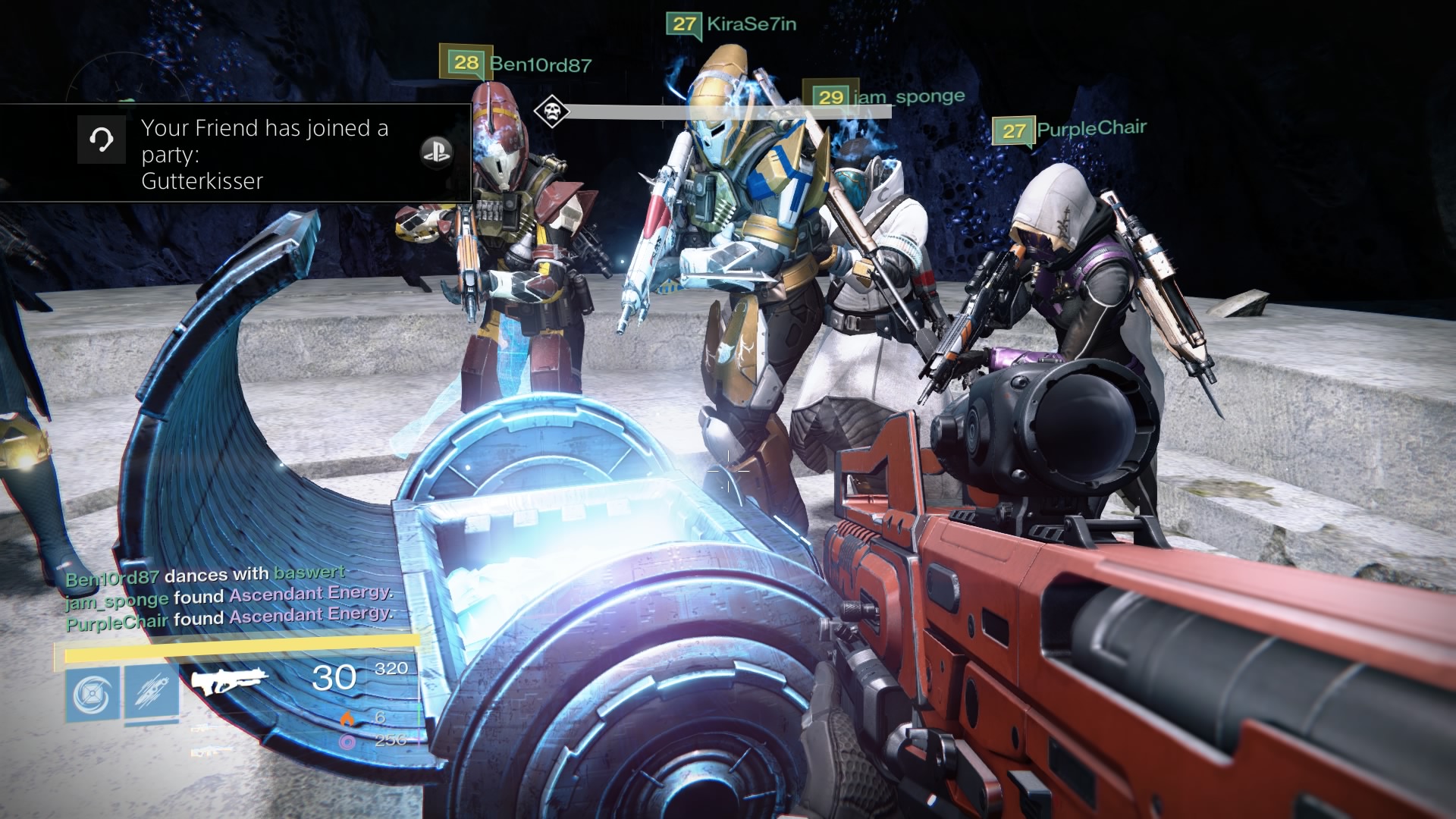
This is demonstrated perfectly through the game’s raid, The Vault of Glass, which I finally experienced for the first time last night. It was such a wonderful experience, utterly unlike anything else I’d done in the game. The challenges were different, the strategies required were different, the environment was different, the type of attention demanded of the player is different, the whole way I related to the game and other players was different.
The Vault of Glass requires you to find a team of six players (you must find the people manually; there is no random matchmaking here), and together you venture down into an entirely distinct part of the Venus map you can’t get to otherwise. A series of obscure puzzles-cum-boss-battles block your passage where you need to do very specific things (keep three parts of the map occupied at once; not be seen by this enemy type; kill that enemy type particularly fast, etc), but importantly, the game never tells you what to do at any given time. Obscure messages appear about rituals being started or whatever, but that’s it. It’s obscure the way Spelunky is obscure: overwhelming, confusing, and intimidating. This obscurity and obtuseness in mission objectives alone makes the raid stand out from the rest of the game.
In our squad of six, three of us had never done Vault of Glass before, one had done it once, and two had done it quite a few times. Very early on one of those two became an ad-hoc leader, explaining how to approach each stage. We’d have these great moments where we’d all stand or sit together on a ledge, and he’d explain what we were about to do. I can’t imagine trying to do this without such a guide. Having such a player to help us through was so rewarding, to feel like you are part of a team with a clear hierarchy like that.
The environment itself deserves applause. You start the raid on the surface of Venus, in an area you wander past all the time, and you open this safe and start venturing down and down and down into the planet. There’s gaping black chasms and narrow little crawl spaces. Vast labyrinths and heavy metal shrines. It feels distinctly like you are travelling down into some other place you have never been before. It sounds like a silly analogy probably, but it just constantly reminded me of watching The Fellowship of the Ring as the fellowship march through Moria. Our leader and more competent players would be Gandalf and Aragon at the front of the narrow path, leading us more confused little level 27 and level 28 Hobbits through the darkness.
In later challenges, half the fireteam are sent to a different place from the other three. The three that remain have to defend a pillar to keep a stargate open so the other three can go get an item, kill some things, and then return. Those on the outside tend to go radio silent and you just hear the short bursts of commands of those three who are in the other dimension. It’s such a strange feeling in a multiplayer co-op game: being so detached from what they are doing. For there to be two distinct squads, and not just more of you shooting at more of them. Maybe this would feel less distinct to anyone who has done raids in an MMO before but here, with twice as many people as a normal Destiny strike, that feeling of being part of a larger struggle was really satisfying.
Importantly, Peter Dinklage doesn’t say anything. He doesn’t ruin moments with terribly delivered exposition or obscure lure or telling you to go read something on Bungie dot com. It helped me realise just how evocative and interesting Destiny‘s world is when it doesn’t have an overlay of terrible story that makes you cringe at every noun.
The Vault of Glass felt not just unlike any other moment of Destiny, but really unique in my experience of videogames. When we finished it, three hours after we started, I was buzzing. Just absolutely buzzing. Being part of such a large team to fight our way through something so unforgiving and challenging and confronting together. That feeling that we all did it together. Now I want to go back and do it again with people who have never done it before, and pass on that knowledge I have learned. If there’s one thing Destiny has mastered, it is making you feel like you are learning, and like you could help other people learn.

On Increpare’s Slave of God
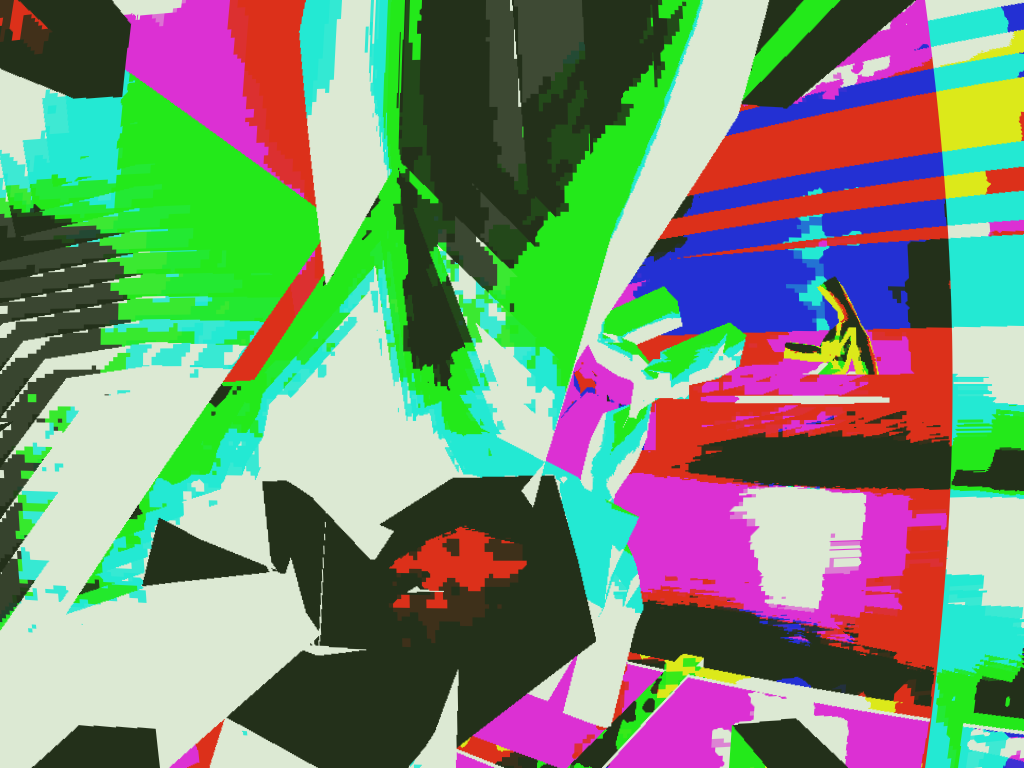
I’ve spent the last few weeks writing a first draft of a thesis chapter on Audiosurf and Slave of God. The point of the chapter is to find a way to talk about sights and sounds in videogame experience beyond some kind of reductive way that sees them secondary to ‘interactivity’. The point of the Slave of God section in particular is to highlight the really direct experience the player has with audiovisual design in that game, where looking and listening are really direct engagements with that game beyond and largely separate from what the player is ‘doing’ at any given time.
I’m not going to get into that here, but while writing it I was struck by how little writing there seems to be on Slave of God, which is sad because it is such a wonderful and important little game. Cara Ellison wrote a short ‘Wot I Think‘ at Rock Paper Shotgun, which gives a really wonderful description of playing it, and Merritt Kopas briefly mentions the game in her talk “Interrupting Play: Queer Games & Futurity” (PDF) where she makes the astute observation that Slave of God “chooses to emphasize
intensity of feeling in order to create an experience that is in a way ‘truer’ than a photorealistic representation might be”. Which really gets to the heart of why I find Slave of God so interesting: it’s a game about simulating a certain real feeling rather trying to depict some kind of realistic space.
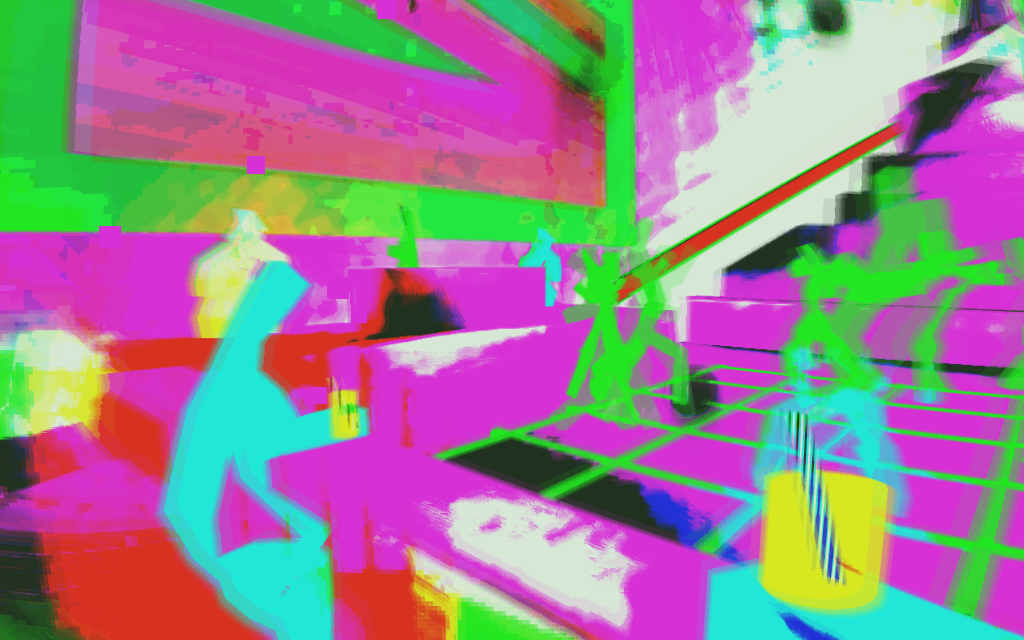
SO. Slave of God is about going to a nightclub. You start with this really basic, minimal, kinda chill menu screen which is just a throbbing orange circle. You click on it and after a moment the game loads and you’re just smashed in the face with this barrage of noise and colours. I’m not sure exactly how Stephen Lavelle created these effects, but the result is something like putting on 3D glasses and looking at an analog television tuned to the wrong channel while trapped in some weird dimension where everything consists of watercolour paint and it is raining. Lines and textures throb over adjoining walls but don’t shift with perspective, as though the three dimensions of this space are irrelevant to them. The colours of people and cups of alcohol and dancefloors smear and blur in the spaces around them. The music is a simple, looping, dance-y track that morphs and twists into different melodies depending on what part of the nightclub you move to.
Movement is key. Movement is all you have, really, and it’s in movement, trying to move, and trying to figure out how to move that the game best captures that feeling of being lost and confused and disorientated in a club. Since the colours and lines and flashes and strobing lights have little to do with the dimensions of space, trying to move around is incredibly difficult. You bang into walls and look at your feet and end up in the bathroom when you were trying to go to the dancefloor. You get to the dancefloor and you end up dancing with the stranger and the camera locks onto them and you can’t escape because the buttons you would use to strafe and get away just spin you around and around and around and any sense of space you did have just falls from your grasp. Suddenly you’re on the stage with the DJ. Or suddenly you’ve fallen off a ledge onto the bouncer guarding the VIP room. Or you’ve just slipped off the dancefloor on the opposite side of the club than you thought you were on.
I hate the vast majority of clubs. I can’t stand the terrible remixes they play, mostly. When I turned 18 and started drinking and going to these places like you are meant to do at 18, they all just seemed so terrible. But eventually through friends I found this club in Brisbane called The Depot. It was a bit grunge-y and very hipster-y. Instead of terrible remixes of top 40 songs, they’d just play this great mix of older and newer alternative stuff. B-52s Rock Lobster or New Order’s Blue Monday or Battle’s Atlas or some Yeah Yeah Yeahs or Le Tigre. Just a good mix of songs you really enjoyed that you could just jump around to like some stupid kid. The Depot closed eventually and the DJs moved on and made another club called Common People. Once I jumped off the stage at that place (during Battle’s Atlas, I think. Or maybe Clap Your Hands Say Yeah’s Skin Of My Yellow Country Teeth) and smashed my head on the low concrete ceiling. The point is, we had some pretty big nights. We’d dance a whole heap and then just kind of collapse on these couches in the back corner on the far side of the speakers until 3am.
The point of bringing that up is that Slave of God feels like being back in one of those clubs. The same sense of disorientation. The way you have to squint to figure out where the walls are because the darkness and flashing lights have destroyed your retinas. The way you get trapped on the dancefloor. Most of all, there’s this corner you can find in Slave of God you can escape to where the barrage of sound is dampened and the colours aren’t so violent. Behind you, back towards the dancefloor, everything is kind of small and far away and still absorbed in this chaos of colour. Like you have noclipped out of the level and are looking down on it from afar. Just getting to that corner and taking a break because the game is so physically exhausting on your senses couldn’t not feel more like fleeing The Depot’s dancefloor back to the couches and just collapsing at 2am, maybe even sleeping for a bit if the bouncer doesn’t catch you.
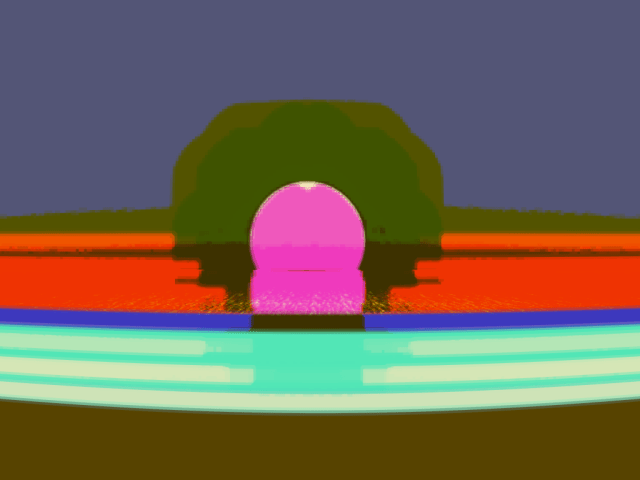
I’m not sure how exactly you ‘finish’ Slave of God, but eventually you’re one of the last people on the dancefloor and you stagger back out of the club. All the colours and lights and sounds are gone and it’s all just black now. You can’t see the walls at all. You just look at your feet and stagger out just the sun begins to rise into the sky.
It’s difficult to talk ‘about’ Slave of God without just describing what it is like to play Slave of God. It’s not a game about intelligible meanings or mechanics or interactions but, as Kopas notes, an intensity of feeling. Trying to describe it in words is like trying to describe a guitar solo or the taste of a meal. It’s just something you experience through your body. You look at it and you hear it and it just kind of overwhelms your senses and it’s pretty special how it does that and you should totally play it.
Notes on Alien: Isolation

(All screenshots from my own playthrough. More available here. Some are from later in the game, though, so heads up.)
1. Isolation is a wonderful game. A confident game. Mark Serrels called it a brave game. Much like with Spec Ops: The Line, it’s the kind of game I look at with this dull kind of bewilderment that a publisher would release it like that. It’s one of those beautiful, daring games that manages to get past publisher focus tests without being sanded down to an impersonal round blob. It still has its imperfections and hostilities and roughness and personality that so few triple-a games are allowed to have. It’s the kind of game I don’t doubt countless developers are capable of making, but which I trust so few publishers to allow to exist unscathed without some injection of gamer-satisfying ‘content’.
2. Videogames have a long history of being influenced by the Alien franchise; though, usually more by Aliens than Alien. Almost every sci-fi shooter’s depiction of technology and spaceships and space marines can be traced back to Aliens in some form or another. Isolation, though, feels like the videogames industry has finally figured out that Ripley’s experience in those films is vastly more interesting than Hudson’s. It feels like the triple-a game that finally realises that an ‘interactive’ medium (urgh, sorry) can offer pleasures beyond power fantasies, that a woman engineer good at surviving is more interesting than a man soldier good at shooting stuff (which, really, is the theme of the three Alien films I’ve seen). It is one of those rare, beautiful triple-a games that is dedicated to ensuring the player is not the centre of the world, that they are not powerful, that they are not in charge, that they can not always ‘game the system’ or optimise their behaviour. This sounds hyperbolic, I know, but Isolation feels like part of a broader moment where triple-a games finally start to have some confidence in their creative direction.
3. I should elaborate on that. There are long periods in Isolation where nothing happens. Nothing. There is no alien after you, there are no enemies. You just walk somewhere and pull some levers and walk back. There are few triple-a games confident enough to include down-time, those stretches of time where the player has to work that bit harder to be engaged, where the game isn’t actively stimulating them with explosions and puzzles. The Last of Us has some great down-time moments, but almost always seems to eventually lose its nerve and interrupt them with an unnecessary firefight (the hydro-electric dam is a good example of this). Isolation, meanwhile, keeps its cool. It plays out its long, long stretches of down-time, and they just work. They stand on their own without some eventual necessary silly challenge to interrupt them. There are moments in Isolation that feel more like Dear Esther or Thirty Flights of Loving than any triple-a game I’ve played. There’s this sense of confidence and maturity (and, yes, of braveness), to not need to fill the game with an arbitrary amount of ‘content’ or features. It feels like a triple-a game directly influenced by the rise of ‘walking simulators’, of those games whose primary goal is to just let the player be present in a world. Isolation is rightly applauded for its emergent encounters, but it deserves no less praise for the times it is strictly, aggressively linear in a way few triple-a games dare to be. Both the open emergence and the strict authoring contribute to the same goal: a world where the player is not in charge, but merely present.
4. And what a world to be present in! The molecules of dust floating in the beams of light shredded through a vent. The framing of the great orange planet against the silhouettes of office chairs and the lazy blinking terminal lights in the darkness. The cables draped along a corridor. Isolation takes the most conventional of sci-fi videogame settings (drab, utilitarian, grey space station) and through framing and lighting turns it into this amazing, evocative place. Walking into a corridor and watching the fluorescent lights flicker on one after another down the hall to the dull buzz of electricity never gets old. When nothing is happening in Isolation, when I am just going to the one place I need to go to advance the story, just being in this world is enough.
5. Sound design, too, is incredible. The wind howls through corridors, computer terminals beep incessantly in dark rooms, metal warps and bangs as an alien scampers through the air vent over your head. An android cooly says “let me help you” as it walks up to you to break your neck. Just the atmosphere of this game is so well realised in every aspect. There is a feeling the game is going for, and the sheer craftspersonship of the audiovisual design achieves it.
6. Of course, where Isolation truly stands out is its encounters. Three main types of enemies: humans, androids, and the alien. Humans and androids are predictable in their behaviour the way enemies in stealth games are usually readable: you learn what they will react to and what they won’t. That said, they both remain refreshing encounters in their own right. The humans throughout the space station are not ‘bad guys’. Each is just trying to survive and while they commonly have itchy trigger fingers, they’ll leave you alone if you leave them alone. The best part about this is that, for once, it actually felt wrong to kill humans in this game except as last resort self-defence. I killed two humans through the entire game, each when I was cornered and about to die. Neither kill was neat, each was messy. My character is not a hunter in this game; she’s a survivor. The androids, meanwhile, are wonderful. They come after you cooly, never running. They walk after you, passive aggressively complaining about how you are wasting your company time. You walk away from them, trying to keep your cool as you put bullets back in your revolver and they keep walking. You don’t look behind you because that will slow you down. You just hope they haven’t caught up to you yet. I love the idea of a stealth game where enemies don’t raise an alarm, don’t freak out, don’t call for backup, but just walk after you. It’s so strangely terrifying.
So while humans and androids are learnable but still interesting, the alien is something else. It feels sentient and autonomous. It feels organic and unpredictable. It feels less like some strings of code reacting to other strings of code and more like an active and independent agent doing whatever it wants. Which is where the game’s most wonderful emergent behaviour arises from: walking through this room might be fine, as the alien is all the way over there; but it might also be impossible as the alien is hanging out in an air vent right in the middle of it. The game doesn’t know, and it can’t help you. It’s almost like a computer virus in the software. It does what it want. Within certain constraints, of course, but it ultimately feels like the designers made this digital beast then let it loose. This is what makes it so terrifying: that knowledge that it is unpredictable and not leashed to the designer. It really could be anywhere. Some sections will be more scripted than others, but you never really know which ones. At any time the alien might be autonomous. You, player, are not the only active, intentional agent in this game. That is terrifying.

7. More important than how each kind of enemy functions is how the interact together. Androids go after other humans as they would go after you. The alien ignores androids but will leap on other humans with as much vigour as it will jump on Ripley. The most wonderful emergent moments happen in these interrelations. One time, I opened a door and a woman was on the other side. She seemed as terrified to see me as I was to see her. She raised her shotgun and I ran. I hid behind a box, but she knew where I went. I was holding my pistol, but I was pretty much screwed. She walked up slowly, shotgun gripped. She turned the corner, pointed it at my face– and the alien leapt on her and I ran and hid in a locker and never looked back. That wasn’t scripted! That was this incredible, wonderful emergent moment that happened to me and not to anyone else. That feels so special, and the game does it again and again and again.
8. Save points are very far apart in Isolation, which is perhaps the main criticism I have seen people make of the game. It is frustrating at times when you are forced to repeat twenty minutes of play because the alien decided it wanted to jump out of a vent right in front of you at just the wrong time. Once, the alien stabbed me from behind as I was using a save point! I get the frustration people feel at this, but for me it mostly works. The fact I haven’t saved for a long time makes me more committed to my life. I am more likely to waste every bullet in my revolver to take out a single android than I am to want to repeat all this section again. I am more likely to just cower under a desk for ten minutes. Originally, I was scared that having to repeat large segments would ruin the atmosphere: do it once, die, then you know where everything is and you just do it a second time without any of the tension and fear. But this never happened. Each timed I died and redid a section, the alien always acted differently. I was never just repeating myself. I was always having to constantly adapt to this unpredictable, autonomous agent. So dying became less frustrating and more an opportunity for a different experience, for different emergent moments. That said, there are times around key story moments where an autosave should happen (and strangely, this does indeed start happening in the final moments of the game). Around certain cut-scenes or moments where the alien is definitely somewhere else and you are not about to be trapped, an auto-save should occur. But for the most part, the manual save system they have is the only option they had: there is an autonomous beat in this game the designers have little control of. You can’t autosave around an unknown variable.
9. Another main criticism I’ve seen has been on the game’s length. To be sure, the game could be a lot shorter. In terms of pure story pacing, it is glacial and slow and not a whole lot happens. Ultimately, it does overstay its welcome (which is somewhat fitting since every Alien film I’ve seen seems to have one or two more encounters than they really need). The story certainly has its moments, but it ends with the most disappointing and dragged out fizzle. Still, many other story beats do hit their mark during the game. After I went through medical, I felt like there was nothing else that could top that segment of the game where you are one-on-one with the alien for so long. Not long after that, there is a long period of time where there is not even a threat of alien encounters. But then something happens and this long slow buildup seems worth it, and it kind of really works. When Ripley first heads to the space station, the pilot of her ship says they have twenty-four hours before she has to leave. The rest of the game after this just simply feels like you are experiencing every single moment of that twenty-four hours for Ripley. Never really leaving her or jumping forward in time. Just, seeing what she goes through. And for that reason, I find the length mostly works. That uninterrupted-ness. More surprising, perhaps, is that despite its length it never once felt bloated to me. No gimmicky sections wedged in until the very end. No unnecessary shootouts. Only one moment I recall with an annoying timer that forces you to do things quickly. A few sections make this or that gadget temporarily useless and force you to adapt in new ways, which feel more fresh than anything. I guess, more than ‘long’, Isolation is slow. Very slow. And I love that. I want more slow games.
10. Okay, a general criticism I do agree with: the graffiti is dreadful. Real hamfisted environmental storytelling that works in a zombie apocalypse but not here. It literally vandalises the beautiful set design in the early stages of the game, but fortunately it soon disappears, only ever to be seen again when you return to those early sections.
11. My one major criticism of Isolation is the illegibility of the user interface. In particular, the use of the same assets for interactive and noninteractive objects. The computer terminal you must find to advance the game looks the same as four computer terminals that are mere background. The one you need might flash orange when you are right up next to it, but not until you are already almost close enough to get the ‘Press X’ prompt. There were multiple times in the game I was left walking in circles, more frustrated than frightened, not knowing what I needed to press X on to move forward. I understand the want to reuse assets like this for verisimilitude, but they could at least flash orange from further away. Being lost and disorientated and confused in the game was often wonderful, except when it was purely because a button was camouflaged.
12. A lot of videogames want you to roleplay your character: act like this character would act. Step into their shoes. Usually this creates an irresolvable tension between how the character should act and what the player can do. Niko Bellic is perhaps the exemplar of this. In most story-driven games, I role play the character as best I can, trying to be an actor in this story following my script. That has never felt as easy as it does in Isolation. Not only did I feel obliged to ‘act’ Ripley how I felt she should be acted, but the game made this so easy to do. Ripley is an engineer, not a soldier, and she knows her way around computers and machines better than firearms. So she creates these gadgets that help her out, far more than she does firearms. She suggests solutions to problems that are technical and confuse other characters, and then she goes ahead and does them. I spend all this time flicking switches and pulling levels and welding and typing at computers and doing things on screens that I don’t even understand but I am sure Ripley does. The game is so committed to this roleplay that the loading screen tips are not simply ‘how to play’ tips in the strictest sense, but ‘tips’ on Ripley’s personality: she’s not a violent person but she’ll defend herself if she has to, one loading screen says. Okay, so I’ll shoot back if shot at, but no sooner.
Then there is the fine control over her physical body. Leaning back and forward and around corners. Peaking out of lockers. To use a firearm, you must first hold down one button to raise it up, and another button to fire it. If you press reload, she will put a single bullet in the gun. To fully reload it, you have to hold down the reload button for the whole time. While squished inside a locker, if you want to read your motion tracker you need to first push your head back against the wall (pulling down on the left stick), in this real visceral sense of being crammed in a small space and pushing your chin into your neck. While using the motion tracker in a hallway, Ripley’s eyes focus on the nearby tracker’s screen, and blur out the environment. Hold down L2 while the tracker is out, and her focus shifts to the environment while the tracker screen blurs. It’s wonderful! All these little finesses create this intimate coupling of player concern with Ripley’s physical (and vulnerable) presence. Never has it felt so easy to be a character in a game.

13. The Alien films are interesting as feminist texts. There’s all kind of weird male gaze and ‘mothering’ stuff happening, but there’s also this great, independent, strong-headed character who knows her way around firearms and machines and aliens who happens to be a woman. It’s so wonderful to see Isolation continue that, with a mother/daughter relationship instead of the tired and old father/son one. Amanda Ripley is strong like her mother, willing to put herself in danger to get shit done while the men cower behind their locked doors, just looking out for themselves. I’m terribly unread in film criticism, and I don’t doubt there is no shortage of feminist critique of the Alien films, and I’m sure there will be plenty more written around Isolation (off the top of my head, here is an essay on the male gaze in Alien and Gravity, and here is Sigourney Weaver talking about Isolation and women in games), but it’s just so wonderful to see the franchise’s legacy continued with this strongheaded, young woman character. Ripley is more interesting than Hudson.
14. Isolation functions as a simulator for the kind of cool moments that happen in the Alien films, both the deaths and the near-misses. Kind of like Metal Gear Solid 2 is a homage to Metal Gear Solid, Isolation is full of moments and tropes that evoke scenes of the films without directly repeating them. Spacewalks to manually align satellites, pushed up against a wall with a flamethrower, androids of dubious loyalty and gross milky innards, an AI that is communicated with in a weird white room, a sudden yank into a vent, cowering under a desk. Nearly every dude is a coward or self-serving moron. It feels like the movies and it also nods to them in both the emergent and authored moments. Never mind the authenticity of the environment design itself.
15. Then there is the technology. The CRT monitors and clanky keyboards. The giant keycards and fluorescent lights. The MS-DOS AI and the grainy, VHS video feeds. The pixel-y and vibrant minigames on various terminals. It feels like you have stepped into the world of a sci-fi universe conceived of in the late 1970s. Which is, of course, exactly how it should feel. It seems like such an obvious thing to do, in hindsight, to retrofit the technology to match the franchise, but this more than any other design decision in the game really deserves applause for its foresight. What it contributes to the game’s atmosphere cannot be understated.
16. Here is four minutes of Isolation that I think exemplifies my time with it. I love how much time I spend doing nothing. Just cowering and waiting. The slow pace of the game and the amount time I just wait all just work together so magnificently.
17. Here is perhaps my single favourite emergent moment while playing the game. I watched this man die five times as I kept dying in this area. Each time was utterly different from the last.
18. Walking in Isolation is one of my favourite things to do in any videogames. It feels like this incredible feat of self-control to just walk down a corridor sometimes. When the alien is around, often crouch-walking will move you too slowly from one hiding spot to the next. On the other hand, running will almost certainly kill you, as the alien will instantly be attracted to the noise you make. Sometimes, the only thing to do is stand up and walk. You feel terrified because you are not cowering, and you feel terrified because you are not moving fast enough. It feels wrong but it’s the right thing to do. I can just see Ripley doing it in an Alien film, her entire body trembling and biting down on her lip as she forces her body to just walk up to the elevator, press the button, and wait. I can just see her pushing down the fear and the desire to just run and scream. I do this when I see the Alien leap into an air vent or when I know it is off a different corridor somewhere. Or when an Android has seen me and is coming after me. Just walk, Brendan. Walk. Don’t run. Walk. And breathe. Don’t forget to breathe.

19. Isolation has a crafting system, but it’s simple and not intrusive. It fits, too, as Ripley is a survivalist engineer type character. The stealth is rarely dependent on gadgets or gear (with the exception of the beautifully vague motion detector). You can build smoke bombs and flash bangs and pipe bombs, but none of these will be the solution to any particular encounter. Rather, they only ever feel like things I hold onto ‘just in case’, that I use as a last resort. Once I was in a locker with five armed men between me and a transport car. I leapt out, threw my one flash bang, and stumbled blindly into the car, hitting wildly everywhere in the hope I’d stumble on the button that closes the door before I get shot. The gadgets saved my life multiple times, but never in a cunning, planned way. Always in a desperate-to-survive way. There’s a ‘purity’ to the stealth in that way. It’s all about being quiet and hiding. The gadgets are just there as a last resort.
20. When people tell me they don’t want to play Isolation because they don’t like horror games, I want to tell them it’s not really that scary. The jump scares are few and far between (at least, the scripted ones are). Isolation isn’t frightful so much as it is tense. Always so tense. A tension that rarely relieves itself. Which, really, is very similar to the films. I love it for it. I love that constant tension and how it just glues my senses to the screen and to the speakers and just holds me there in long, torturous suspense. But then, Isolation is frightening. It is frightening because there is an autonomous computer program shaped like a xenomorphic alien lurking in the software and hunting you down, and no one is controlling it. This isn’t a ghost train at an amusement park where all the monsters are safely chained up. This is Jurassic Park after the electric fences fail. The designers aren’t going to keep you safe here. This isn’t going to be fair. There is a thing out there, and it has a mind of its own and it is coming for you. It’s wonderful and, okay, that’s pretty frightening.
21. I love a videogame with consistent commitment and focus to tone. I love a videogame that is able to take advantage of the resources and labour available to triple-a development without falling prey to the failings of design-by-committee where a videogame often feels more like a frankenstein of bits than a unified whole. I love a triple-a videogame that feels like it shouldn’t plausibly be able to emerge from the conservative, averse publishing model that would rather see a game be inoffensive to everyone than really meaningful to a few. Isolation is one of those games. There’s other things I could criticise, like how the cut-scenes run at about ten frames a second, or the occasional unconvincing deus ex machina of conveniently placed items. But overall its commitment to its style, to its tone, to its disempowerment of the player from start to finish, its downtime and uneventfulness, its unleashed spontaneity—its overall dedication to evoking a certain sensation is so well-realised. It’s willingness to let you fail. More than simply a good game in the Alien franchise, Isolation feels like an important moment. Or, rather, part of a broader important moment where triple-a game development begins to realise (or, at least, to be permitted), to simulate a broader range of experiences than just action-packed power fantasies. When a publisher like Sega is willing to release a game where I cower under a desk for fifteen minutes, I feel pretty good about where videogames are going.

Notes on Destiny

1. Destiny is a ‘well designed’ game in the way a chair might be well designed or a lampshade might be well designed. It is the IKEA Billy bookshelf of videogames: safe, sturdy, inoffensive; as a Billy bookshelf does a very competent job of being a bookshelf in the most generic, conventional sense so that there is not a home that a Billy bookshelf would look strange in, Destiny is a very competent game in the most generic, conventional sense. It’s the safest possible game Activision and Bungie could have created. Like some kind of ur-videogame object. Maddy Myers said on Twitter yesterday that it looks like the kind of videogame you would see in the background of a film, and she’s not wrong. It is derivative, generic, and conservative; but not in the sense that it fails to achieve some innovative greatness that it is aiming for. Rather, it is clearly derivative, generic, and conservative by intent. It doesn’t want to be something creatively progressive or imaginative. How then to evaluate it? I typically like to approach a game on its own terms. Not in some sort of ‘authorial intent’ kind of way. Rather: what does the game tell me about what it is striving to achieve, and how well does it achieve that? Destiny tells me it just wants to be a safe, competent videogame object, and it achieves that very well. So therefore it is ‘good’, I guess. But there is nothing here critically or meaningfully or thematically. There’s no depth. It’s a bookshelf. It’s an object. But it wants to be an object. Ok then.
2. A conversation I’ve had with various friends over the past week has gone like this: “I see you’ve been playing Destiny,” they say. “Have you been enjoying it?” “Yeah,” I answer. “It’s pretty good.” “Cool, so do you think it’s worth picking up then?” “Wellllll,” I reply. “It depends.” It feels like these chats are performances of the conflicting feelings I have with this game. I can’t deny that I am certainly enjoying Destiny. It’s a good, solid grind. Just like Borderlands before it, it’s a treadmill that is pleasurable to run on sometimes: you’re not going to go anywhere interesting, but sometimes just running in an air-conditioned room while watching some numbers go up feels pretty good. So two claims that the rest of these notes will boil down: 1) I am really enjoying Destiny. 2) There is nothing particularly interesting about Destiny.
3. Destiny is Halo+Borderlands. It simply is. That is neither an insult nor a compliment (though, it will probably be one or the other of those pending on how you felt about those previous games). It has Bungie’s solid, heavy, snappy feel that they mastered in the first Halo game and replicated in each one they made afterwards. It has Borderlands‘s FPS-but-an-RPG-ness with damage numbers spraying off enemies and depleting health bars and a constant, repetitive grind that feels good to get caught up with sometimes. But it also lacks Halo‘s compelling every-thirty-seconds strategising, constantly forcing you to constantly rethink your situation based on the particular assemblage of enemies and equipped weapons you find yourself entangled it. It also lack’s Borderlands‘s evocative, over-the-top and self-indulgent style.
4. These comparisons deserve deeper exploration. First, Halo. Many of Destiny‘s connections to Halo are explicit: recharging health, limited guns, the kind of floaty-but-good feel to jumping, regular shifts to third-person, an annoying blue orb bereft of both body and personality. Different crosshairs are lifted from Halo, such as the giant round circle for the shotgun (itself resembling Halo‘s shotgun more than a little bit). Like Halo, guns feel meaty and punchy. Melee attacks feel incredibly satisfying and solid. Punching someone as the tank class feels like you just punched a giant, taut drum. Using a knife as the hunter class feels like stabbing a blade into several layers of stretched, thick plastic wrap: that split-second resistance before it just pops through. Throwing a knife and killing an enemy with a critical hit that was more luck than skill is immensely satisfying. Like Halo, Destiny feels good at its core of pulling-a-trigger-while-pointing-at-some-aliens, and that carries the game a long way. Also like Halo (and also like Oni, really), Bungie is not afraid to repeat Destiny’s environments over again and again. They will have you walk down the same corridors time and time again to kill the same enemies time and time again. I don’t think this is laziness so much as a confidence that exploration is not why you are playing this game, a confidence that the only role of ‘space’ here is to create an area for you to shoot things in. It gambles that that core loop of shooting things will be satisfying enough that you don’t care that you aren’t actually going anywhere interesting: Earth World wasteland, Moon World wasteland, Venus World wasteland. Halo was the same, with repeated level segments and stages that were other stages backwards. In Halo it never bothered me (though it certainly bothered others) for I was at least progressing a story. In Destiny, though, I am already beginning to tire of seeing the same spaces over and over again. But I keep playing because it feels good. So maybe Bungie’s gamble paid off.
5. So there is a lot of Halo here. But Destiny also lacks what made Halo interesting. It’s hard to over-estimate just how satisfying Halo‘s battles were with the explicit hierarchy of enemies: cowardly grunts, elusive jackals, and cunning elites. Every single elite felt like fighting an equal to Master Chief, and they felt that way, in large part thanks to the many grunts and jackals backing them up. Every encounter was a strategy of figuring out how to pick off the small enemies without being destroyed by the elite, so that then you could destroy the elite without being destroyed by them. It was a juggle of weapons, where individual weapons did not matter so much as what combination of weapons you had. There was so much moment-to-moment strategising that people often fail to appreciate, instead remembering it as the conventional run-and-gun modern shooter that it helped to normalise on consoles. Destiny lacks that. It has interesting-to-fight enemies, to be sure. But they are all the same except for a slightly different placed weak point. Some areas are satisfying to fight in, constantly moving and spinning and throwing knives and grenades. But it’s all grunts and no elites. Even the tougher enemies like wizards don’t require any real kind of strategy, just more bullets. It’s wrong to fault Destiny for not being Halo, but as its similarities help us detail its strengths, this difference helps us detail its weaknesses: Destiny is not strategically interesting. It is just running-and-gunning.
6. Okay I’ll get back to Borderlands soon but I seem to be talking about enemies now. I do like the enemy design of Destiny, even if they are as creatively unimaginative as the rest of the game. Each race has a wonderful style and animation, and are fun to shoot at even if it is straightforward. The later races, The Vex (Cylons) and The Cabal (Warhammer 40,000 Space Marines) are particularly enjoyable as they crumble and collapse. It’s like everything in Destiny: solid, well-crafted, satisfying, just not… interesting.
7. Okay, Borderlands. Destiny has clearly been heavily inspired by Borderlands‘s hybridising of first-person shooter gameplay with roleplaying game grinding and levelling. But where Borderlands goes for the over-the-top absurdity in both style and tone almost as an excuse for its own gameiness, Destiny plays it with a straight face. It reminds me, in a lot of ways, of the original reveal trailer for Borderlands before they changed the art style to be something actually interesting. I don’t think Borderlands-with-a-straight-face is necessarily a bad thing. Borderlands‘s humour got very old very quickly. But in style, I always appreciated that Borderlands embraced the fact it was junk food. It never pretended to be anything it wasn’t. You shoot an enemy in the head and they explode in blood, block letters, money, guns, and ammo. All this junk that then gets sucked up into you. It knew that the pleasure it offered was hoarding loot (the very story of looking for the Vault reflected this). Destiny though, is so much more serious about things. Sometimes you pick up little rectangles of ammo. Sometimes little hexagons that give you a picture in a square to let you know you picked up an item. Sometimes, if an enemy drops money, it will spray out of them in a satisfying shower of blue cubes. But then, you can’t pick those cubes up! They just sit on the ground while the interface says ‘+25’ to let you know you picked up 25 cube-dollars. I wouldn’t go so far as to say Destiny pretends to be anything it isn’t (as I say above, it is content to be the very derivative and safe thing that it is), but if Borderlands is junk food then Destiny is like buying a salad from McDonalds.
8. But now I am going to counter that previous note by talking about how much I love the user-interface design of Destiny. It’s menus are sincerely a pleasure to navigate. It’s heads-up display is a nice blend of solid colours and fully-spelled-out words without too many jargony symbols. I like what it looks like! Having to control a cursor with the thumbstick at first seemed counter-intuitive, but the way this allows the game to have roll-over menus is really quite remarkable. Whereas in Borderlands I would always go out of my way to avoid the menus for as long as possible because they were just such a horrible and ugly drag, I’m never annoyed by Destiny‘s menus. I almost look forward to entering them, I enjoy their design so much. This is something that is remarkably rare in videogames, a menu that is enjoyable to navigate, and is I think the one true commendable accomplishment of the game. It helps the game so much that its framing in its menus and its HUD is so satisfying. It gives the game a confidence of style, even if that style is so conservative.
9. And, to swing back the other way, let’s talk about the story, which, I assume, was written by a semi-sentient fax machine. ‘The Darkness’ is attacking ‘The Light’ who must be protected by ‘The Guardians’. ‘The Fallen’, ‘The Hive’, ‘The Vex’, and ‘The Cabal’ are bad. It’s easy to mock Peter Dinklage’s terrible voice acting (and it certainly is terrible), but it’s not like he had anything at all interesting to work with. The semi-sentient fax machine spat out some @videogames_ebooks words in vaguely coherent sentences, and he did the best he possibly could do with them. What strikes me as weird is that they even bothered to get a big name actor in the first place. I guess it gave the press something to write about at an early stage. But it creates this weird dissonance for a game that is so apathetic about its own story to have a known actor talking at me. By large, I don’t care that I don’t care about the story, and I don’t care that the game doesn’t care about the story—that’s not why we’re here. But then, occasionally, it has these long drawn-out cut-scenes where suddenly it decides your avatar is now a voiced character for a little while, like these brief hiccups where Destiny mistakes itself for a story-driven game. And then you go back to fighting The Bad Guys on The Planet with The Gun. But kind of like the repetitive worlds, the story doesn’t matter. It’s not what is meant to keep you here. That core shooting-things loop is what is meant to lure you in.
10. The casual drop-in-drop-out multiplayer is interesting. I enjoy the lack of commitment, of just stumbling across people and then leaving them again. Almost like a shooter equivalent of Journey. It has its hiccups, when I think I’m with a group of people and then turn a corner to find they have all disappeared. But, for the most part, it works fluidly and inconsequentially, which is wonderful. Its very seamlessness feels like an impressive technological and design accomplishment. Perhaps the only one in the game.
11. Destiny does not do its own systems justice. For fifteen levels of grinding, your character’s development is linear, their options limited, the places you can go and the things you can do defined quite narrowly. It is not until you get closer to level twenty that you begin to unlock other missions and more interesting gear and alternative subclasses. It’s not a ‘deep’ game by any means, but there are systems there that are still quite elegant and interesting, especially when you join a fireteam with other players and learn how your abilities complement theirs. But for hours upon hours, none of this is hinted by the game. With the exception of specific upgrade screens, there are no greyed out boxes hinting at vast unexplored potentialities, or loading screen tips suggesting prospective future decisions. It feels like it is going nowhere for a long time. It expects you to trust it. I have not reached the endgame yet, and even though it has begun to open up in more interesting ways, I am yet to be convinced there is going to be much there to convince me to go back and walk the same corridors and fight the same enemies over and over and over again just to get a better character to do the same thing over and over and over again. It’s fun for a time, but there’s not a whole lot there trying to convince you to stay.
12. In six months time, I don’t think anyone will be talking about Destiny anymore. It is a well-designed videogame object. A thing. A consumer product that was made to be purchased and consumed. It is ‘digestible’ as Push Me Pull You Michael McMaster said to me yesterday. Something I can see myself doing for a while, something that I will enjoy going through the motions of for a bit. But something so lacking in creativity, imagination, and personality. Destiny is a well-designed object crafted by people who are clearly talented at making this kind of object that does the things that this kind of object does. Like a piece of IKEA furniture. Like a chair. Like a lampshade. I’ll appreciate it for a while, and then it will just blend into the lounge room.
13. Two months after posting these Notes, I am still playing Destiny. I have written some further thoughts on it here.
Notes on Swing Copters

1. Swing Copters is, clearly, the follow-up to Dong Nguyen’s Flappy Bird. You can see it in the art style with its vibrant colours and riffing of Nintendo motifs (the girders and hammers vividly recall the original Donkey Kong). You can feel it in the obtrusively difficult playing where getting a single point can take an afternoon of repeats. You can feel it, most clearly, in the brutally unforgiving hitboxes that give no leeway to the player. Draw a square around the outer-most limits of every sprite, and there is its hitbox. An invisible square corner beside a hammer hits an invisible square corner beside your helicopter-cap, and you’re dead. It feels cheap at first , just like Flappy Bird, but, over time, comes to feel like the game has its own unique syntax that requires you unlearn whatever rules you know about how virtual objects should work together.
2. But Swing Copters is also very much unlike Flappy Bird. Like any sequel or follow-up, it’s how it contrasts with its predecessor that it is most interesting, as it is in these differences where you see the designer’s growth most clearly. By all accounts, Nguyen was conflicted with Flappy Bird’s explosive success, and loathed the idea that he might have created something that people got addicted to. In Swing Copters, then, you have the same kind of simple-yet-tough gameplay, but presented in a far more obtuse manner. Flappy Bird’s success was in how easy it was to ‘get’. Even if your first game’s score was 1 or 2 points, you still felt like you got it, like you could do better if you practiced. The ol’ “Easy to learn hard to master” proverb written on the first page of every game design handbook is what worked in Flappy Bird’s favour. Swing Copters, meanwhile, does not give up its secrets so easily. You can’t begin to ‘learn’ Swing Copters until you figure just what the hell is even going on. In Flappy Bird, that first tap that commences the game also teaches you the central mechanic: tap to go up. The first tap in Swing Copters, meanwhile, merely starts the game. You get no hint of what you are even controlling from it. So you go into the game blind and, a second later, you have swung wildly to the right and died against the edge of the screen with a score of zero. I spent a good five games not even knowing what a tap achieved, my death came so quickly. Eventually, I figured out a tap changes directions. But even then, getting through that first gap took over a dozen games as I tried to account for inertia, hitboxes, and the constant vertical movement of my little avatar. It’s for this reason that Swing Copters will not find itself a dedicated following as strong as Flappy Bird did. They’ll all download it, to be sure, but many will give up instantly, disappointed to not find Flappy Bird’s quick fix. But I sense that is Nguyen’s deliberate (and quite clever) design decision. He doesn’t want this game to hook you. He wants you to give it your time voluntarily and consensually, and it will stand back and wait for you to come to it. It won’t meet you halfway.
3. Game designer Chris Bell said on Twitter, in a conversation with Bennett Foddy and Zach Gage, that Swing Copters was a “two-handed Flappy Bird”. It was this conversation I watched in my timeline that convinced me there was enough to Swing Copters to be worth putting up with so many terrible runs: if these game designers saw something of worth there, it was all I could do to find it. At first, Bell’s idea of a two-handed Flappy Bird didn’t make sense to me. Both games are played in portrait mode, making them perfect for single-hand play (the weight of the phone leaning on your fingers while your thumb taps the lower-right corner. But Swing Copters requires a frantic and inconsistent rhythm of tapping, especially as you attempt to stabilise your avatar to rise in a somewhat straight line. Tapping it that fast with the phone held in a single hand makes the phone wobble violently and leads to your inevitable demise. Holding the phone in two hands, meanwhile, and tapping with two thumbs, leads to a confusing disconnect between the direction travelled and the side of the screen tapped. Eventually, I settled on holding the phone in two hands, like I’m saying a prayer almost, while still only tapping with one finger. This holds the phone steady while I tap frantically to whirl around in a straight-ash vertical line. It reminds me of the early days of smartphone gaming where the first puzzle of every game was figuring out how to hold this thing in your hands. They don’t tell you how to hold them the way a gamepad does or the way a keyboard and mouse does. I’ve missed that initial exploration of how to approach the phone in my hand when I play a new game.
4.Rhythms. That is how Swing Copters most differentiates itself from Flappy Bird. Flappy Bird’s rhythm was slow and steady. It was learnable. It was a trustworthy beat. Play enough and you could almost close your eyes as you went through the next three tunnels. There was a beat and you either had to tap on the beat or let it pass. That was the whole puzzle. Swing Copter, then, is the improv jazz pianist, requiring frantic rapid-fire taps followed by sudden and precise lulls. It’s less “tap to turn” and more “stop tapping to turn”, I think. You can’t find an easy beat. The spinning hammers and your flailing avatar together demand a constant attention. In Flappy Bird, if you got to 20 you could get to a hundred. In Swing Copter, getting to 20 is no promise you can get to 21.
5. A cynical claim I’ve seen repeated (usually with the admission that it is indeed a cynical claim, at least) is that Swing Copters is hard purely to make you look at more ads. For one, this accusation ignores the fact that Swing Copters allows the player to make a one time in-game transaction of about a dollar (region pending) to remove all in-game ads. Swing Copters is, effectively, an up-front payment mobile game like those games of olde, but one that also lets you play without paying. Hardly something to complain about. But even if it was more difficult in order to make you see more ads, it would hardly be the first game whose design has been influenced by how it makes money. Know why your $60 game has a boring sewer level and a tacked-on vehicle level? To make the game feel like it has $60 worth of content. The doing-it-for-money accusation predominately shows its head when someone wants to discredit a type of game rather than actually make a valid criticism of that game.
6. Swing Copters isn’t for everyone. Many will find it obnoxiously difficult, or difficult-for-difficulty’s-sake, or (most reductively) as a ‘vertical Flappy Bird’. For me, though, having now put in the effort the game demanded for me (a labour not everyone will be willing to devote, understandably), it feels like a mature, confidently designed game by a designer who is consciously aware of the strengths and failings of his previous creation and, more important still, listened to his audience at the right times, and ignored his audience at the right times.
7. Here is a short video of me playing Swing Copters (not that well):
Notes on P.T
1. P.T is a ‘playable teaser’ that serves as the reveal for Kojima and Del Toro’s upcoming Silent Hills. It is, on its own, a spectacularly confident game and a finely honed horror experience.
2. A single corridor. The player, moving the character in first-person with slow, delayed kind of meaty first-person controls, walks down a single corridor, past a clock. The corridor turns to the right at a window where there is another door on the right, an alcove up ahead, and, beyond that, another door. The door right at the end will, once you walk through it, take you back to the door at the start of the corridor. The game loops over and over in a literalisation of the Groundhog Day rhythms of playing any videogame. Each time, something about the corridor is slightly different: a door ajar, a broken light, a muttering radio station or dreadful silence. Or, sometimes, nothing is different at all, and the frights from the previous cycle are still just sitting there, now strangely comforting in their familiarity. It is when they disappear again that you get worried.
3. The intimacy you feel with this corridor over time is deep. You learn its every alcove, every possible corner something might jump out at you from (but they always find somewhere else). The simple corridor is delicately designed. Simple things like needing to turn a corner, with that bathroom door just to your right are so deliberate. Each cycle you hold your breath as you turn that corner, just waiting for the cycle that they inevitably go for the cheap scare. You could turn before you get to the corner and sidestep up to it, but then what if something attacks from the window? Or from the small alcove behind you? There is always somewhere you aren’t looking, and the game is paying very close attention to that. But then you turn that corner and, every time, the entirety of this cycle reveals itself to you: is the bathroom door closed, open, or ajar; what colour is the light down towards the other door; is the door at the end of the corridor open or closed? Each cycle is split into these two parts: the reluctant and tense walk down the first part of the corridor, and the slow hesitant turn to look down the second part of the corridor to see what has been put before you this time.
4. The looping over-and-over rhythm of the game works exquisitely to instil a deep, bubbling sense of terror. The game doesn’t throw scares at you ever second, but you feel like it could throw scares at you any second. Even if you are stuck in a loop, the same corridor repeating over and over as you try to figure out if you are meant to be doing something to progress or if you just have to keep going, it still feels like something could attack you at any moment. Many horror games, you can confidently expect no more scares until you figure out how to progress; in P.T you are not sure if you are progressing or not, so the scares could come at any moment.
5. More on ‘getting stuck’. Teaser reveals for different games are often deliberately obtuse puzzles that require a community to come together and solve (and be advertised at and be part of the advertisement themselves). Portal 2‘s reveal is a good example of this. That kind of deliberate obtuseness mostly works in P.T‘s favour. It’s interesting because, playing alone, you can become incredibly stuck. Later cycles require you zooming in on the most obscure little scraps of paper to trigger the next cycle. Sometimes it is unclear if the game has started again or if it is still going. I used an online guide at multiple points just to keep going. Just how you make the final cycle trigger is still, it seems, being contested on various forums. I couldn’t make it happen, but I kind of like that. I like that the game defeated me. It, eventually, got to a point where I was so mentally and physically exhausted from how on-edge this game had made me over a couple of hours that I just had to stop. But my point here is this: P.T doesn’t have to concern itself with conventional notions of clarity or intuitiveness because of what it is trying to achieve, and for a game where you (both player and character) are trapped in this hellish corridor for eternity, that works in its favour.
6. Also talking about the rhythm of the game, I was impressed at how confident it was not to exploit every opportunity for a jump scare. Early on it hits you hard, throwing things in your vision and revealing what the ‘thing’ looks like very explicitly. I assumed this was the end of the game, when it happened, and cursed when it wasn’t. But by revealing things so early with such a blatant jump scare, the game then had me exactly where it wanted. It punched me once and then laughed at me every time I flinched when it moved a finger. “Just hit me already, damn it!” I actually yelled at the television at one point, later on, as I ran into a room I’d been avoiding only to have nothing happen. It was hell. Other times, something will change slightly just to freak you out. But then you get used to that change over multiple cycles. And then the game sets it back to how it was before and freaks you out all over again.
7. Once you get the flashlight, you can, if you are gentle on the controller, move the light around without moving your head. Move the right thumbstick to the left and the torch light goes to the left a moment before the head does. This allows you to stand before a wall or a cabinet and gently wash your torchlight over it while standing still, without requiring any more buttons. I really liked this, that the torch wasn’t tied to my character’s neck, and its a subtle form of aiming I’d love to see more of.
8. P.T feels like what happens when the resources and labour of a large studio (and a large publisher) aren’t constrained to normative ideas of what a $60 triple-a game must be like with certain amounts of ‘content’ and ‘choice’ and ‘interaction’, whatever any of those words mean. Except, of course, P.T is constrained to normative ideas of what the advertising for a $60 triple-a game must be like (over-the-top, polished, self important, a puzzle in its own right). But in itself, as its own experience, it feels like a snapshot of what is possible when a large, well-funded studio/publisher works on something small and focused instead of the usual need to always be bigger and better and more (even the title of the game P.T is marketing, Silent Hills, points to a ‘more’ attitude with its pluralisation).
9. I hope we see more playable teasers like P.T.
Website Goes Here
Reply
Hello.
I decided it was finally time to create one central place for myself on the internet, to bring together my various blogs and social media and academic work and freelance work and independent projects. Also, really, it was just time to stop using blogspot.
In the future you will probably find blog posts here, as well as links to things I write/do elsewhere on the net. In those tabs up the top are links to various things I have done or am doing, split between my academic research, independent projects, and freelance writing.
 Brendan Keogh