Videogames aren’t special. Videogames aren’t unique. 

These two sentences, more a mantra than a manifesto, underpin everything I write about videogames, both academically and non-academically:

Videogames aren’t special. Videogames aren’t unique. 

These two sentences are indefensible and easily disproved, but they function for me as a necessary counterweight to the celebratory, uncritical tones that always risk seeping into any discussion or analysis of ‘new’ media forms such as videogames. We like to use neologisms as crutches when we talk about videogames: immersion, gameplay, interactivity, replayability. We take these terms and allow them to stand in place of any attempt to actually understand and describe elements of a videogame’s design or the meaning it conveys to players. Particular and intricate understandings of a game’s style, aesthetic, and rhythms are replaced with the fact it had ‘good gameplay’. Certain people get what you mean by that. 

But counter argument: videogames aren’t special, and they aren’t unique. 

Let’s pretend for a moment these actually are defensible claims. If they are, then there is nothing uniquely immersive or interactive about videogames. Maybe all media forms are immersive or interactive in one form or another, and videogames are just immersive and interactive in particular ways

We rely too often on rhetorical, abstract, vague arguments when we evaluate and analyse a game. These arguments, in turn, rely on the uniqueness of videogames as a medium. They rely on, in other words, an assumption that the thousands of years of art theory and practice built up around painting, theatre, music, dance, cinema, etc. are inapplicable to the videogame form because unlike those forms, videogames are immersive and interactive and have gameplay. 

We see this in the early academic arguments about whether or not videogames are stories. We see it in the more recent essays about how videogames should stop aping the tropes and conventions of cinema to instead do what videogames and only videogames can do (whatever that is). That videogames are unique and special is indefensible. That videogames are better than any other medium is indefensible. 

I do this as much as anyone. It’s intoxicating and naturalised to make these assumptions. It’s all we’ve ever been told about videogames. Videogames are special. Players are powerful and more active than your supposedly passive cinema audience tube-fed a movie. It’s character building. It gives us a medium to gather around and celebrate and claim as our own.

But it hasn’t given us a critical vocabulary to unpack the creative works of the medium. It has instead given us terms that you ‘get’ if you’re in the culture and are alienated by if you are out of the culture. It has given us crutches that don’t get us anywhere. The Last Of Us isn’t good because it has ‘good gameplay’. It is good because of the way one scene cuts to another, the muted punch of the firearms, the gritty and desperate melee combat, the downtime between the moments of heightened action. Tell me about the game and why/how it functions and is engaged with. Don’t just bet that there’s this neologism that we both share an understanding of. 

Every time I make a claim about either videogames as a medium or about what any particular videogame does, this mantra sits somewhere in the back of my head as a constant reminder to keep me in check, to ensure I don’t depend on some videogame exceptionalism to make my arguments. Because how arrogant would that be? After thousands of years of art, how arrogant would it be to think that only now have we, with videogames, created truly interactive and immersive works that give the audience so much power and autonomy and agency and whatever. 

Videogames are not special and they are not unique. Countless creative works in different mediums have worked towards actively involving the player in some form or another, in providing a sensation of entering the virtual world of the artwork through different tropes and formal properties and conventions, for centuries. Actually for centuries. There are books that explicitly incorporate their length or the turning of their pages into their meaning (the simplest example is a page break for a new chapter). The creation of perspective painting played with spatial depth as narrative progression. Panoramas toyed with removing the frame to further immerse the audience in the artwork. Theatre has long requires the same active creation of belief from audiences as videogames do now. What videogames do so well is not a sudden phenomenon. It is a continuation and convergence of a variety of art practices over hundreds of years. 

So if I write a sentence that depends on the unique or special quality of videogames in order to make a point, I challenge myself. When I said this game had good gameplay, what am I actually talking about? I challenge myself to rewrite that claim with real words that mean thing to actual people. People who have never played a videogame can understand the pleasures of videogames because they are neither unique nor special, but they can’t if we rely on unique and specialised languages. Even further: we obscure our own understanding of the videogame form if we refuse to acknowledge and consider the rich commonalities and shared history the form has with other forms that have been around for much longer and are no less relevant thanks to us young upstarts. 

But videogames are clearly videogames. They are not movies nor television nor theatre nor music nor board games nor sport. But they are kinda all of these things. Videogames exist as videogames and are thus differentiated from all these other forms so they must exist so they must be unique. Yes. This is exactly why the mantra is indefensible as an argument. But it’s not an argument so much as a counterbalance for writers against the influences of marketing rhetoric to keep themselves in check, to challenge themselves to actually consider the pleasures and meanings offered by a particular videogame separate from normative and naturalised values that only ever existed to essentialise videogames as somehow ‘different’. 

So I prefer this: videogames are particular. Videogames offer particular engagements with sights, sounds, and interfaces that in turn provide particular pleasures. It is these pleasures the videogame critic should try to understand. Maybe a film or a sport or a painting offers similar pleasures through different methods (or similar methods). Who cares? This particular videogame offers this particular pleasure. I like ‘particular’ because it is more cautious and less celebratory. It acknowledges and allows an appreciation for why videogames are worthy of study on their own terms as a creative medium without celebrating them as starkly contrasted with ‘previous’ art forms. It doesn’t assume videogames are better and it forces us to consider the consequences of not being better than those who are already here. I don’t care if what this videogame did well could have been done equally well by a film. I don’t need videogames to do what no other medium has ever done, because they never will. I just need videogames to offer the particular pleasures that videogames offer. 

VIdeogames aren’t special. Videogames aren’t unique. They are just another medium. Just another creative form. They are no more or less worthy of appreciation or analysis or consideration or respect than any other medium. They don’t need to be lambasted. They don’t need to be celebrated. Each is a conceptual and theoretical cul-de-sac. Videogames offer particular pleasures and, like every other art form ever, that particularity is worthy of consideration. There’s nothing unique or special about that, and I’m a better critic for constantly reminding myself of this. 

This Week

I had a very hectic week trying to get back into writing the one PhD chapter that is yet to be fully drafted while also dealing with a backlog of assorted crap. At the same time, though, I somehow managed to have some stuff published that I’m pretty happy with. So here is a small breakdown of the stuff I wrote this past week:

1. I wrote this small piece at my scrappy blog Ungaming about how we talk about the length of AAA games. It was mostly about the discussion on The Order 1886 that was happening at the time, before reviews were available, where the short length in and of itself was seen as something negative. Since then, the reviews have been published and it does sound like an entirely mediocre game! But the idea that it is bad just because it is short is a problematic notion and I discussed why. One afterthought is that someone made the good point to me on Twitter that a lot of the complaints were likely by reviewers who had played the game but weren’t yet allowed to say they had played it. So maybe they did have reasons they thought it was actually ‘too’ short that they couldn’t elaborate on, which is fair.

2. I wrote this op-ed for ABC’s The Drum on Adam Baldwin’s inclusion in this year’s Supanova festival. The backlash from both Baldwin and gamergaters was about as predictable as you’d expect. Threatening legal action, comparing me to Stalin, calling me a White Knight, etc. Of course, the backlash would’ve been much worse and harder to ignore if I was a woman writing on the same subject, as I reflected in a followup post. Most remarkable was how Supanova itself decided to deal with the criticism. After 20 hours of radio silence, they asked me on Twitter how many Supanovas I have been to, and then pushed for me to provide years. The next question they would ask was obvious: “Have you seen someone get abused at our expo?”.Over on their FB page, meanwhile, they decided it was a piece of ‘hack journalism’. The short-sightedness and immaturity is astounding. Instead of working to understand how they are contributing to an ongoing and systemic problem, they decide to take it personal and demand proof of individual instances. Unsurprisingly, when multiple women responded to the tweet (as bad PR often does, the tweets blew up a bit) to say they had been harassed at Supanova before, there were no more tweets. They essentially, and disappointingly, acted like any of the one dudes that make up movements of Gamergate in the first place, taking a critique of their privilege as a personal slight. You can see this most clearly in Mark Serrels’s look at who is no longer supporting the Expo due to Baldwin’s involvement, and Zachariou’s absurdly defensive responses. Ultimately, the expo has shown over and over that it not only doesn’t care about inclusivity, but that nobody involved in running it even understands what inclusivity actually entails.

3. I wrote this essay at Reverse Shot about FIFA, videogames as moving images, remediation, and realism. I’m really happy with it, as it gave me a chance to discuss how visual things that are often dismissed as stylistic flourishes and fundamental to how a game like FIFA is engaged with. I wrote the first draft of this back before Christmas (it’s publishing got delayed due to my wedding and honeymoon and moving house etc.) but I’m happy how timely it ended up being. Firstly, it fits well in conversation with a few different articles about the relationship between videogames and cinema this weekish: namely, Gita Jackson’s piece on framerates for Paste and Ed Smith’s piece on how games can never be cinematic (an argument I fundamentally disagree with) for Vice. It also fits well with ongoing formalism discussions, as my main issue with ‘game formalism’ currently defined is that it fails to account for a vast range of formal elements of the videogame (namely, audiovisual elements). But that’s a different essay. Anyway, I’m real happy with this essay and I’m looking forward to writing for Reverse Shot somewhat more regularly this year.

4. I recorded this Critical Let’s Play video of Proteus for the 2015 Digital Writer’s Festival. I’m actually really quite happy with it. Recording it on my macbook was incredibly easy, and I enjoyed the one-episode-one-game format, as opposed to my previous Let’s Play videos of longer AAA titles. This is something I might do more of in the coming months. I still have my Patreon account for Critical Let’s Play videos up if that’s something you think you might want to support.

On Metamorphabet

Metamorphabet_4

I first played Vectorpark’s Metamorphabet late last year while judging for the Independent Games Festival awards. It founds its way into my randomly assigned list of games requiring my assessment and was, easily, one of the standout games of the dozens that I played while judging. It’s a simple idea (interactive alphabet book) beautifully realised through intelligent animations and wonderful tactility and is something I really enjoyed playing with.

Each letter is its own little playground of stuff to explore and discover. Things start out quite normal but escalate to a Dr Seussian sense of carefully crafted absurdity as each new element converges with the previous (see the above example of a walrus in a wagon with wheels on the waves). The game never forces you forward, letting you hang out and just play with each letter’s vignette for as long as you want.

I just love the ease with which Vectorpark’s animation shifts from two-dimensional to three-dimensional, sometimes within the same letter. When the cone appears for ‘C’, you become suddenly aware of this third plane on which it can be spun around. It’s sudden and surprising, but intuitive and natural. The vast array of tactilities is remarkable, too, from the fluttery paper feeling of P’s pinwheel or the rickety click-clack of the walrus’s W-wagon, or the mechanical stomp of R’s robot.

I would love to sit down and watch a kid play through Metamorphabet with its self-directed sense of pacing and exploration, but as an adult who already knows his alphabet I still found the game so delightful just to explore and to look at and to touch. I don’t really have much in-depth to say about it other than it is lovely and I hope that you check it out if you have an iOS device.

Here is an interview with the designer.

Here is an earlier little lovely gamething they made called Spider, which I love and which also demonstrates the majesty with which Vectorpark combines the two- and three-dimensional.

My Own 2014

I’ve already written posts on what was my favourite games writing in 2014 and what were my favourite games, so now I should reflect on my own 2014 and link to some of my own work from the past year that I’m particularly happy with.

I did not write as much publicly in 2014 as I have in previous years. I was teaching a first-year course in the Game Design program at RMIT in the first semester of the year, and that took up a lot of my time and energy (and, frankly, pays much better than freelance games journalism). In the second half of the year, I haven’t been teaching but focusing instead pretty obsessively on my PhD thesis, which I’m hoping to complete about mid-2015. This has meant that non-academic games criticism has taken a bit of a backseat this year for fairly practical time-related reasons.

But at the same time, I’ve also found myself fairly exhausted with ‘games journalism’ narrowly defined, even before it utterly failed as an institution to respond to and account for gamergate. Towards the end of 2013 I decided I wanted to stop focusing my writing efforts on game-centric outlets, which demand a very specific set of values and ideologies, and to focus instead on writing for more general ‘cultural’ or ‘literary’ outlets, writing about games for a critically engaged but more populist audience than simply ‘gamers’. That I had decided this at least six months before right-wing pundits started using the gamergate hashtag as an excuse to beat up on any game creator with progressive politics and a non-male gender makes the fact that gaters accused me of disrespecting my readers by being critical of gamer culture doubly amusing.

So this is something I’m really glad to be doing. After writing an essay on Grand Theft Auto V for them last year, I made my debut in Overland‘s print journal in January of this year with a letter to Susan Sontag about games criticism. This is, essentially, the letter I wish I could actually send Sontag if she were still alive, and discusses how exciting and relevant I find her work for my own development as a games critic. I also continued to write for Overland‘s website this year, with a review of Wolfenstein: The New Order and another of Kim Kardashian: Hollywood.

Much like my essay at Unwinnable defending Flappy Bird, my praise of Kim Kardashian: Hollywood is a reactionary one that comes from a place of frustration with most of videogames’ culture’s inability to value videogame works, be they commercial or personal, on their own terms rather than normative design values. There’s an elitist and certainly a gendered tinge to the dismissal of incredibly popular games that shares more than a passing similarity to the dismissal of personal games in previous years as ‘un-games’. I tried to cover that in this Kim Kardashian: Hollywood review.

Also at Unwinnable this year, I wrote some Notes on Luftrausers for the newly launched Unwinnable Weekly magazine. This is my first ‘Notes’ post published somewhere other than my own blog. Sadly, it is also the only piece I am yet to write from Unwinnable Weekly, but hopefully I will pitch some more in the new year.

Another superb outlet I have written criminally few articles for in recent years is Paste, which has published a significant portion of the most incredible writing on games produced this year (not least of all Austin Walker’s many remarkable essays). In addition to all this great writing, they also allowed me to write about Mario Kart 8‘s superb visual worldbuilding.

I was invited to start a column at the film criticism journal Reverse Shot this year, and I have two columns up thus far. The first was, counter-intuitively, about Netrunner and what it teaches us about videogames. The second was about Desert Golfing as a sort of exploration game. More essays will be appearing on this column in the coming months.

I also briefly sustained a column at The Conversation early in the year for the newly launched Arts+Culture section. It was liberating to be able to write for this audience without being shackled to the Science+Technology section, which is where videogames had previously been covered. Most of what I wrote for this column was, I think, mostly forgettable, but my (quite critical) essays firstly on the mass firings at Irrational Games and secondly on Games Evangelism received a fair bit of attention for being, I think, some of the first dissenting pieces on what were largely covered as positive events (at least for a while). In a similar commentary vein, I’ve written three short pieces for ABC’s The Drum this year: one on e-sports, one on Microsoft buying Mojang, and one on Target refusing to stock Grand Theft Auto V.

One piece I am really happy with from the past year is this one that I was invited to write for the American magazine about videogames and masculinity. This was a challenging piece to write, as the editor was determined that a common audience unfamiliar with videogames could understand it, something that I greatly appreciate it. I’m also delighted by the really great art that was produced to go with the print version of the story (viewable in a gallery on the above link).

On my own blogs, I continued writing the ‘Notes’ styled reviews that I started last year, and people seem to really enjoy these. These more list-style reviews are incredibly liberating in being able to jump from one idea to the next without feeling constrained by the need to have paragraphs flow together or for the piece to have one, over-arching theme. For getting out all my thoughts on a single game, I’ve thoroughly enjoyed writing them. I wrote some Notes on Final Fantasy XII before I brought my old blog, Critical Damage, to a close. On this new blog I wrote some Notes on P.TSwing CopterDestiny (which I followed up with some more thoughts a few months later), and Alien: Isolation. The Notes on Destiny and Isolation were particularly popular; the former due to the lack of reviews published before the game’s release, I think, and the latter mostly because I think the developers shared it around on Twitter.

I also maintained a secondary blog this year, which has been confusing and probably not the greatest strategy for my #brand. I started my tumblr ungamingfirstly, so I could use tumblr more and actually have somewhere to reblog gifs of Japanese movies I’ve never heard of; and secondly, so I could maybe start writing about stuff other than games somewhere. This hasn’t really happened yet, but I’ve still found tumblr a liberating outlet for posting half-formed ideas and long, rambling, top-of-my-head rants that would otherwise be cut up and jammed into fifty tweets. Here, my thoughts on Mountain and on Netrunner‘s Scorched Earth are probably highlights. I also used this blog for many of my thoughts on gamergate, but more on that below.

This year I also started playing around with video capture. Personally, I don’t find Let’s Play videos particularly interesting to watch, and I find most video essays, regardless of the quality of the content, frustrating as I could just read a written version essay in half the time and without having to pause my music. Despite this, I found making videos and talking my way through gameplay deeply satisfying, and it offered a range of new avenues for analysis that writing does not necessarily allow. My Critical Let’s Play series of the Call of Duty: Modern Warfare trilogy was well-received, and I am currently following it up with one of Max Payne 3. I want to continue learning how to use video content in the new year, and plan to try not only more Critical Let’s Play series, but maybe also some more experimental, one-off videos as well. I am using a Patreon page to experiment with funding myself to do this, if that is something you are interested in.

And then, finally, we have gamergate. Ignoring gamergate was impossible as a videogame critic this year. More than impossible, as a straight white male game critic not (for the most part) in the crosshairs of the vile mob that participated (and continues to participate) in the harassment and abuse of woman game creators and critics, I feel I had an obligation to speak out again this violent and revolting movement. At first, this speaking out was more destructive than constructive, arguing directly into the hashtag with those attacking critics and developers. This, I eventually figured out after others told me, is only really using my privileged position in fireproof clothing to fan the flames. Gamergate, I eventually figured out, was something much better spoken about than to. Those that participate in gamergate have no interest in hearing two sides of an argument but only in defending and strengthening a certain, male-dominated status quo, and their logic and position will shift from tweet to tweet in order to defend that position. Talking to those already consumed by the movement achieves nothing. Talking about the movement and all its issues, on the other hand, is an important part in stripping the movement of any guise of credibility.

This is what mainstream games journalism utterly failed to do for weeks after the movement started, choosing instead to stay silent or to only report on the ‘isolated incidents’ of death threats received by various women without a mention of the broader movement responsible. It wasn’t until journalism more broadly (The GuardianThe New York Times, etc.) started reporting on gamergate that games journalism had the courage to discuss it as, explicitly, a misogynistic movement. Ironically, in its campaign to discredit a seemingly progressive institute of games journalism, gamergate had the ultimate result in me losing any faith I had in games journalism as anything more than enthusiast, consumerist press.

My main essay on gamergate, when the movement was only a couple of weeks old, was this essay at Overland, which, amusingly, is the only ‘anti-gamer’ essay of those early weeks that I’m aware of that actually uses the word ‘death’ in the title. None of the ‘death of gamer’ articles decried by gamergate actually use the word death at all. For what it’s worth, the title for my piece was chosen by Overland‘s editors, not myself, which is really just further proof that gamergate’s crying foul of the clear conspiracy to report on all these Literally Dead Gamers is absurd. I also wrote many tumblr posts during gamergate, usually in response to this or that particular moment that some gater said something absurd or that some games journalism outlet responded in an utterly irresponsible manner. Before the movement had solidified under the gamergate hashtag, I wrote this post about the abusers’ inability to comprehend scale of production and this post about how games journalism is part of the problem. I wrote this post after a bunch of harassers on twitter jumped on a tweet I wrote that said “gamers are shit people”. Last I checked, screengrabs of the tweet were still going around the hashtag as proof of my utter lack of ethics. I wrote this short story analogy when Kotaku US made the poor decision (in a series of poor decisions) to disallow their writers to contribute to Patreon projects, thus giving the gaters the idea that not only did they have a justifiable point (they didn’t), but that they were actually being listened to (they were). I wrote this post after realising that attacking gamergate directly did more harm than good and that it was quite likely there was no shortage of decent-but-gullible people caught up in the movement that needed to be informed about what they were caught up in. I no longer really think this is the case (if you are still supporting gamergate after this long, you have no excuse really), but I think it was important at the time. This post is about how gamergate is able to persist because they are the powerful status quo, and this post is explaining a joke that was so straightforward that it doesn’t really need explaining, and anyone who misunderstood it did so deliberately in order to exploit it. And, amusingly, here is me joining a larger conversation over a year ago about the issues with the ‘gamer’ identity. Almost like we were discussing these issues long before gaters came along. I have not written more on gamergate more recently (except tweets), but I can’t stress enough how much it is continuing to have a damaging effect on the lives of the most important people making and writing about videogames.

Due to gamergate, I’ve seen no shortage of excellent writers, mostly those that have emerged from the games criticism blog-o-sphere, feel cheated and disillusioned and ultimately abandoned by mainstream games journalism in the wake of gamergate. Many of them have talked about (if they haven’t already) quitting games journalism entirely because of the lack of support there for any writing or author that does not pander to the core readership of these outlets, which is the same demographic to whom pandering is responsible for gamergate in the first place. I hope these writers don’t stop writing about videogames, but I hope they do abandon games journalism. I hope many of us come to realise that games journalism is such a narrow slither of places that videogames can be written about. For my part, I’m going to continue to distance myself from core games journalism and write for more generalist audiences in outlets that don’t only write about videogames. I also want to get better at consuming media that is not videogames, and writing more about that. I’m tired of being game-centric, and I think videogames and their players need to be not the centre of the world far more often. There are a lot of good people in games journalism, to be sure, but the structure of the industry ultimately ensures that the most interesting writing around videogames is not supported. I think it is telling that not one piece of my favourite pieces of writing about videogames from the past year was published on an outlet that focuses solely on videogames. So, from the privileged position of not ever having been totally dependent on my freelancer income, I think it is safe to say I am done with games journalism narrowly defined, more or less, and I think many of the most interesting games critics feel the same way. There are so many more interesting outlets with more mature readerships that offer more support to their writers who are now, more than ever before, interested in videogames. Games journalism doesn’t need progressive and critically thinking writers, but now more than ever, those writers don’t need games journalism, and that’s something I’m very excited about.

So 2015 will see a lot more writing from me, a few more videos, and hopefully a completed PhD! I would also like to write another book about a single videogame, at some point (Driver: San Francisco and the metaphysics of videogames is one I’m strongly considering). Another thing that might happen in 2015 is either a return to creative writing, or perhaps I’ll finally learn how to actually make games. After so many years of academic and critical writing, I’m certainly feeling the urge to just make stuff again. Or maybe I’ll just spend all my time trying to write a better tweet than this one.

My Favourite Writing About Games in 2014

2014 has been a whirlwind of a year full of travelling and pumping out tens of thousands of words for my PhD. I certainly did not read as much as I have read in previous years, but a lot of what I did read left a great impact on me. Still, this caveat is my way of saying that you should not take this list as an absolute ‘Best of’ games writing of 2014 but just a list of games writing that made enough of an impact on me that I have remembered it to include on this list. You should certainly also keep an eye out for Critical Distance’s and Good Games Writings end-of-year lists for more great stuff that I’ve not included here.

David Sudnow – Pilgrim in the Microworld

People have been telling me for years to read David Sudnow’s book Ways of the Hand. In it, academic and jazz musician David Sudnow recounts the deeply embodied and phenomenological way the hands learn to play jazz music at the piano. It’s not only a terrific descriptive analysis of how jazz piano music functions, but of how consciousness is not the only way to know things. We know things in our hands, in our feet, in our mouth. It’s why we don’t have to consciously think just to walk down a footpath, and why a slightly too-large shoe that effectively makes your foot longer than your body knows it to be can trip you up with every step. Body knowledge!

This is, of course, incredibly relevant to videogame play. Especially the idea of hands learning and knowing fine motor skills. It’s an incredibly relevant book for thinking about how hands function in videogame play and videogame literacy. It inspired me to write my own academic article (forthcoming… hopefully) about what the hands know at the gamepad controller, the way you roll your thumb across buttons so as to press two adjacent buttons at the same time. Things like that. Halfway through a draft of this article, I thought maybe I should look at Sudnow’s second book, Pilgrim in the Microworld. Pilgrim in the Microworld, it turns out, is about videogames.

It does not offer the same close phenomenology as Ways of the Hand, but it is no less descriptive and insightful in its analysis of early videogame culture. Discovering this book, published in 1983, felt like finding a 1980s downtown arcade perfectly preserved under a glacier, complete with the un-ageing people who frequented the establishment. Pilgrim in the Microworld starts with Sudnow playing Missile Command at a friend’s house and being immediately enamoured by it, immediately wanting to understand what this weird thing is. He goes out and buys his own machine and becomes obsessed with Breakout!. He must get the perfect game, and he dissects the game, its development, its culture to get there.

What most strikes me about Pilgrim in the Microworld is how effortlessly Sudnow conducts himself when confronted with this new artform. He is excited, to be sure, but not carried away by that excitement in the way that too much writing about games, even today, is. He is not trying to defend videogames or glorify them. He is not trying to make sure some core gamer-identifying readership feels really righteous about their hobby. He is trying to understand this thing and he does it with this fidelity and nuance, as an utter outsider to the medium, that so few people even today are capable of. His ability to link videogames to pre-digital games, to television, to software engineering, to popular youth culture at the time, is just so remarkable in its effortlessness.

On top of this, it is just a really good, timely read. People often say Killing is Harmless is the first book about a single videogame, but Pilgrim in the Microworld is effectively an entire book dedicated to appreciating Breakout! written nearly thirty years earlier, and it is so marvellous.

Pilgrim in the Microworld is out of print, and Sudnow sadly died in 2008. I’m sure if you looked around the internet you might be able to find a pdf somewhere, though. I can’t recommend highly enough that you do this. Not only is it a significant and overlooked piece of videogame criticism history, it’s also just a very good book with observations as relevant today as they were two decades ago.

Samantha Allen – “Mario Kart 8 and the Centipede’s Dilemma”

http://www.pastemagazine.com/articles/2014/07/mario-kart-8-and-the-centipedes-dilemma.html

I read Allen’s terrific piece about trying to teach a friend how to drift their kart while I was a) trying to write the above mentioned article draft about how fingers learn gamepads; and b) not long after having a similar experience with my partner and Mario Kart 8. Drifting in Mario Kart 8 is so difficult to explain to somebody, but so crucial to being able to not only play but to enjoy that game. It’s the kind of thing that you, eventually, just ‘get’. But just ‘getting’ something is not useful when you are trying to teach someone how to play a game. Finding vocabularies for this stuff is so important, and Allen does a phenomenal (and phenomenological!) job of drawing that out.

Austin Walker – “Real Human Beings: Shadow of Mordor, Watch Dogs and the New NPC”

http://www.pastemagazine.com/articles/2014/10/real-human-beings-shadow-of-mordor-watch-dogs-and.html

This article is such a solid, solid piece of writing. ‘Personal’ writing around videogames, especially after New Games Journalism got way too popular, is often criticised for not just being ‘subjective’ but for not really talking about the game at all, instead using the game as an excuse for the author to talk about themselves. It’s an easy trap to fall into, and one I have certainly been guilty of myself (though, really, I’m not sure a piece of writing not being really about the game but instead using the game to talk about something else is necessarily a bad thing). Walker’s article is terrific because it threads together personal experiences of race in America with analysis of two games that, on the surface, seem utterly different. It takes a complicated topic, grounds it in relevant broader discourses, and wraps it all up in personal, located experience.

Anna Anthropy – ZZT

http://bossfightbooks.com/collections/books/products/zzt-by-anna-anthropy

Videogames culture needs more histories. We know the dominant narrative of Spacewar! to Pong to Atari to Mario to PlayStation very well, but it’s a narrative that is very linear and which is very tidy at the risk of obscuring a whole lot of fascinating messiness.

Anthropy’s ZZT achieves this not by trying to write a ‘history of videogames’ narrative but instead focusing on a very specific history of a community that formed around a particular game in a particular time. When I read ZZT, I had this real sense that this was an important historical document. Here, on these pages, is the retelling of something that happened in videogame culture, recorded for the ages. That seems like something we need a lot more of.

I always found myself really impressed with how effortlessly Anthropy moves from the analytical to the nostalgic to the historical to the personal. She takes us from a personal anecdote to how she played ZZT as a kid to a finely detailed but still accessible detailings of how the game works (an invaluable setup for readers such as myself who have not even seen a screenshot of ZZT) to discussions of its code makeup to the communities that made this code do what they wanted it to do. It’s so grounded, so accessible, and so clear and, unsurprising for Anthropy, so grounded in a broader sense of culture and politics and not just Videogames as this thing disconnected from the rest of society. Easily the best book produced by Bossfight Books to date.

Darius Kazemi – Jagged Alliance 2

http://bossfightbooks.com/collections/books/products/jagged-alliance-2-by-darius-kazemi

Look, it’s no Killing is Harmless but it is pretty good, I guess.

In seriousness, Kazemi’s attempt to find a different approach to longform game analysis as different as possible from my overly-interpretative textual analysis is a nice, easy read, and provides a solid ‘making of’ style analysis of Jagged Alliance 2. A lot like ZZT, it provides a valuable historical account of what this game is and why it exists. I wrote more about Kazemi’s book in relation to my own book here.

Maddy Myers – “’Troid Rage: Why Game Devs Should Watch Alien—and play Metroid—Again”

http://www.pastemagazine.com/articles/2014/08/troid-rage-why-game-devs-should-watch-alienand-pla.html

I missed this piece when it first came out, but went back and read it after I played Alien: Isolation and was trying to find writing about that game. This piece is not about that game, but is uncanny and almost prophetic in what it says Metroidvania games can learn from Alien and Ripley considering Isolation then proceeded to do many of these things. Reading this piece, I felt like I understood Isolation better, which is remarkable considering it predates the release of that game by a few months.

Maddy Myers – “Femme Doms of Videogames: Bayonetta Doesn’t Care If She’s Not Your Kink”

http://www.pastemagazine.com/articles/2014/10/femme-doms-of-videogames-bayonetta-doesnt-care-if.html

Bayonetta was never my kind of game, and so I have no interest in playing the sequel. What I did love about the first game, however, was all the interesting and intricate discussions that emerged around it that pointed towards that complex position of the player as both actor and viewer and how concepts like ‘the male gaze’ really struggle to encompass that hybridity. In this piece, Myers advances those discussions that started around the first Bayonetta and inevitably restarted with the second one. She covers a lot of ground and holds together a lot of threads while being neither reductive nor obtuse. It’s a really great piece of writing! I don’t personally feel so strongly about abolishing the idea of the male gaze completely, but it makes a very compelling case for thinking more critically about it as a concept. This is probably one of the few pieces from this year that I didn’t just ‘enjoy’ reading but from which I think I really learned something.

Michael McMaster – “On Formalism (re: Mountain; videogames; watching ice melt)”

https://medium.com/@michaeljmcmaster/on-formalism-a1b4e95bb435

McMaster is one of the developers of Push Me Pull You, all four of whom are smart and critical and engaged thinkers and creators. When everyone was struggling to figure out how to even approach the iOS game Mountain without feeling angry or cheated or pretentious, McMaster wrote this post about formalism that got right to the heart of things, explaining less why Mountain is or isn’t good, but where you even need to come from if you wish to even begin to understand it at all. It was a pretty crucial article for my own figuring out how I felt about Mountain.

Zoya Street – “Impossible, Impermissable, and Queer: Rules, norms and laws as theorised in Japanese games blogging”

https://medium.com/interlingual-critical-writing/impossible-impermissable-and-queer-41e45657ff21

Street is a really important historian and critic if only because he manages to tap into so many different histories and discourses that it is incredibly easy to ignore. I really liked this analysis he did of a conversation in the Japanese videogame blogging community not only because the content of those blogs, blocked off to most Western readers by the boundary of language, is valuable to a broader audience, but his analysis of those blog posts gives us a significant lens on how other cultures and languages are approaching videogames ontologically and, in turn, better help us to understand how our own language and culture is responsible for our own way of understanding videogames.

Zoya Street – Delay: Paying Attention to Energy Mechanics

http://rupazero.com/delay/

Street also published a book this year. I proofread an earlier draft of Delay, and its title is a nod to an academic article of my own called “Paying Attention to Angry Birds” (shucks). Delay is important because it treats seriously a game element that it is too easy to just dismiss as exploitative and cheap: the energy mechanic of casual and social games. Casual and social games are so often dismissed because their moneymaking motivations are so transparent. I guess we prefer our corporate products to whisper sweet lies to us while they try to make a profit. I have a personal agenda in treating mobile and casual and social games seriously, understanding what they offer instead of just dismissing them outright simply because they are are anathema to core gamer and game design values and aesthetics. Street does the same here, closely analysing energy mechanics and understanding them rather than dismissing them, drawing together developer interviews and game analysis to do so. In a world where casual game design ideals and engagements are clearly visible in blockbuster games like Destiny, with its daily and weekly challenges and dripfeeding, paying attention to this stuff is incredibly important. We’re lucky we have Street.

Ian Williams and Austin Walker – “Working for the Love of the Game: The Problem with Blizzard’s Recruitment Video”

http://www.pastemagazine.com/articles/2014/08/working-for-the-love-of-the-game-the-problems-with.html

This article sort of serves as a follow up to Williams’s 2013 article at Jacobin about the games industry (you should read it) with more critique of how the games industry presents itself to both players and potential employees. The games industry’s (and the tech industry’s more broadly) obsession and mining of ‘passion’ is well-document, but always demands more scrutiny. Williams and Walker do a great job of it here in relation to a specific recruitment video offered by Blizzard. If you find this stuff interesting and can deal with something a bit more academic, I can’t recommend strongly enough that you read de Peuter and Dyer-Witheford’s Games of Empire.

Leigh Alexander – Life Hacks: A Netrunner Story

http://www.shutupandsitdown.com/blog/post/test/

This article convinced me to try Netrunner and, perhaps more importantly, convinced me to stick with it through that steep, early learning curve. It’s still probably the best piece of writing that really captures the magic of Netrunner.

Adam Saltsman – VANQUISH RETROSPECTIVE

http://pastebin.com/m0xLSKzg

Hands down my favourite piece of writing about a videogame written in 2014. I love everything about this piece, not least of all its punkish existence on pastebin (I’ve archived a copy for my personal library because we cannot lose this piece). Saltsman’s exegesis on why Vanquish is such a good game feel like a Tim Rogers article, like something I would normally read on Insert Credit. It just rolls on and on and on and goes from the fine-grained to the broad to the historical to Speed Racer and back again. It’s just a remarkably concise and enjoyable piece of writing that so succinctly communicates why the author thinks this game is great. When developers write this well about videogames I get anxious about my own relevancy.

Geoff Keighley – The Final Hours of Titanfall

http://www.finalhoursoftitanfall.com/

All I knew of Keighley before reading The Final Hours of Titanfall was some joke about Doritos and Mountain Dew and Halo, and some apparently terrible videogame award show that, despite being terrible, every American I follow on Twitter insists on watching every year. So I felt pretty bad when, reading this, I realised he is also a pretty good games journalist!

A very mainstream, industry, enthusiast games journalist, to be sure, but a good one! This book (well, ‘app’) uncritically relies on words like ‘gameplay’ and ‘immersion’ more regularly than I would usually like, and is sometimes positive about its object of study the way a studio-sanctioned Making Of documentary on a movie’s DVD release often is, in that way you’re not sure if you are just consuming a long ad or not. But despite this, Keighley tells the bizarre and fascinating story of Titanfall and, through it, the even more bizarre and fascinating story of Respawn studio, the phoenix studio of the Call of Duty creators after they fled Infinity Ward and Activision. I felt like I was given a lens onto triple-a game development that I so rarely have access to. Weird little things like how the developers spent a year trying to making Titanfall work in the Rachet & Clank engine, and how the ongoing lawsuit with Activision affected the studio’s culture. It’s so rare to really be able to comprehend and understand why a triple-a game is the way it is, so this book was greatly appreciated.

Cara Ellison – EMBED WITH GAMES

http://embedwith.tumblr.com/

Ellison’s whole EMBED WITH GAMES project has been so great to read and so exciting to watch form. I love the way she focuses on people and, through those people, often manages to say something interesting about a particular group of people, or even a scene. I love how Ellison just embraces the subjective and the gonzo, and I love the insights it allows her to make. She shines the spotlight on some incredible people, some only previously known as obscure online celebrities, but many others not known at all. In each case, Ellison’s ability to render them as human is such an important jolt to how we think about games as things that people make.

Dan Golding – The End of Gamers

http://dangolding.tumblr.com/post/95985875943/the-end-of-gamers (and http://dangolding.tumblr.com/post/101639865598/some-things-i-shouldve-said)

This blog post isn’t even called The Death of Gamers! Gamergate sure did revise some history! Anyway, one of the first posts that the Gamergate followers wilfully misread in order to feel slighted and righteous remains a really great and scathing breakdown of the problems with the ‘gamer’ label, how it was cultivated, and who it serves. Golding’s follow up post is also worth a read.

Dan Golding – Notes on Ubisoft’s Charlotte Corday

http://dangolding.tumblr.com/post/88625164678/notes-on-ubisofts-charlotte-corday

During the backlash towards Ubisoft when they foolishly claimed they didn’t have the resources to create playable women characters (and thus implying that everything they did have the resources for is more important than women), Golding wrote a tweet that was a particularly great burn. It got retweeted and retumbled thousands of times, so Golding elaborated on it with this post, which is also a great burn.

Dan Golding – A Short History of Video Games

http://www.abc.net.au/radionational/programs/shorthistoryofvideogames/

Not really writing, but Golding was commissioned by the Australian Broadcasting Corporation to create a four-part radio series on videogame history. I’ve only listened to the first two parts so far, but it does a great job of both telling the popular, dominant narrative, but also acknowledging that that is just one narrative, and talks to a lot of great people who really help to complicate things while also keeping it accessible to a broader, Radio National kind of audience. The Australian focus on the history is refreshing, too, but doesn’t prevent this from being worth a listen for international people as well.

All of David Kanaga’s blog posts

I got way into David Kanaga’s old blog posts early this year while reading them for PhD research. I wrote a primer about how to approach them here.

Liz Ryerson – “Indie Entitlement”

http://ellaguro.blogspot.com.au/2014/06/indie-entitlement.html

Ryerson continues to be one of the most valuable voices in videogames. She has this wonderful ability to be simultaneously polemic and nuanced, unforgiving and consolatory. I just really like her writing and really appreciate her voice, even (especially) when it challenges or counters my own thoughts. This post, in response to a video about Phil Fish and internet celebrities, breaks down the issues with mainstream ‘indie’ and its hegemonic tendencies.

Liz Ryerson – “on ‘queerness’ & making things for yourself”

http://ellaguro.blogspot.com.au/2014/01/on-queerness-making-things-for-yourself.html

Just another really great piece by Ryerson that is challenging and important. Particularly for me as I’ve previously used ‘queer games’ as a catchall phrase in places I probably shouldn’t have.

*

So that is some good writing that had an impact on me this year! Of course there was also the start of Unwinnable Weekly and The Arcade Review, both of which have been full of great and regular writing, independently published. And also a stack of important writers moving to Patreon like Lana Polansky, Mattie Brice, Merritt Kopas, Aevee Bee, and Cameron Kunzelman. All have written articles that I have enjoyed this year, and it is exciting to see them find ways to be supported beyond an enthusiast press that is more concerned with not losing a core readership of gross gamergaters than in actually supporting diverse voices. I think it’s telling that not one article I’ve mentioned in this post is published on a games-centric outlet. Here’s to next year continuing the trend of great writers looking to write about games for outlets beyond the traditional, outlets of ‘games journalism’ narrowly defined.

Some Thoughts on Darius Kazemi’s Jagged Alliance 2 and my own Killing is Harmless

After I released my book Killing is Harmless in 2012, the response was overwhelmingly positive. I’m pretty sure that was mostly just because someone had written a book about a videogame, however, and not due to any inherent quality of the book. That’s not me trying to be modest or putting down my own work (I’m still pretty chuffed that I wrote it), but as some pointed out at the time, probably the most shared piece of information about Killing is Harmless at its release was its word count. It was an exciting book first and foremost simply because it existed, regardless of what it actually said.

Some people, though, wrote some really important and really great scathing reviews of it. Cameron Kunzelman wrote this one, and Darius Kazemi wrote this one. Both Cameron and Darius are good friends and both are incredibly intelligent writers and developers, so I really valued their feedback and critiques of my work. Because, truly, I had no idea what I was doing when I wrote Killing is Harmless. I didn’t even know I was writing a book for most of it! While many took the sheer size of it as a sign of its authoritative stance on what Spec Ops: The Line is ‘about’ (I still cringe every time I see somebody say it is ‘the last word’ on the game, or that there is no need for anyone else to write anything because I’ve already said it), I always intended the book to more modestly be ‘Well, I really enjoyed it and I think this is why’ and also ‘I have no idea how one should even write long-form criticism but let’s try this way and see if that works’. Maybe that just sounds like I am trying to defend myself with retrospective caveats, but Killing is Harmless was always really just an experiment that was taken way more seriously than I anticipated (which, truly, is one of its faults).

So Kazemi wrote his review (which I strongly encourage you to go read before reading this post). Then, this year, he authored his own book about a videogame, Jagged Alliance 2 for Boss Fight Books. It’s a really good book and I highly recommend it! It is also about as different an approach as you could take to analysing a videogame as Killing is Harmless is. Whereas my book was deeply interpretative (something I’ve come to regret; I’ll get to that below) and really just asked the question ‘How did this game allow me to have the engagement with it that I had?’; Jagged Alliance 2 instead asks ‘How is this game a thing? What humans and nonhumans and circumstances and code came together to mediate each other to make this thing into this thing?’. As Daniel Joseph explores in his own post on the book, Bruno Latour’s Aramis is a large influence on this approach that Kazemi takes. Kazemi follows the actors (the creators, the publishers, the other games that came out around the same time, the state of the games industry, how long it would take the code to compile, etc.) to try to understand how Jagged Alliance 2 came to exist as it exists in the time it came to existence.

The other book that Kazemi notes was influential on his own writing is Killing is Harmless. Not methodologically in the way Aramis clearly was, but in a reactive ‘Well if I didn’t like this book about a videogame, how would I write one?’ kind of seed way. That’s very flattering!

In the comments of Kazemi’s review of Killing is Harmless, there’s a conversation between us where I probably fail at not sounding like a slighted, misunderstood artist (you just don’t get it, man). I note in that wall of text about how what interests me about Spec Ops: The Line is how it is such a broken game that shouldn’t even exist. Like, it simply shouldn’t. It’s commercially unfeasible. It’s a game that reflects the anger and frustration of its own development, as I found out months later when I actually spoke to somebody who worked on the game for the first time. As with Jagged Alliance 2, there is a very interesting story to tell about Spec Ops: The Line in regards to ‘How is this even a thing that exists?’. About how (as far as I can tell) 2K really wanted their own military shooter franchise and threw Yager at it and then threw Walt Williams at Yager and then everyone making the game realised they hated this kind of game and all that anger and spite found itself in this beautiful mess of a game. The Aramis analysis of Spec Ops: The Line would have been fascinating. But I didn’t do that. Instead I just spoke about myself and how I felt about the game. Knowing now what I didn’t know about the game’s development then, I see how that approach would’ve been frustrating to read.

Going to go sideways for a minute here and work my way back: through 2013 (the year after I released Killing is Harmless), I read a whole bunch of Susan Sontag’s work. In particular her essays “Against Interpretation” and “On Style” had a dramatic influence on how I think about my own videogame criticism. You can probably find those essays pretty easily but, essentially, Sontag hates metaphor. An artwork, for Sontag, isn’t about X, it is X: a painting isn’t some melancholic ode to loneliness; it is a painting. She insists that the critic has to stop trying to look past the formal properties of an artwork to interpret its ‘content’, and instead talk about how that content (what the artwork is ‘about’) is emergent from its formal properties. Which is true, right? Any themes or meanings or tones or atmosphere of any work of art emerges from how its material, formal properties are arranged (how they are able to be arranged and how they are not able to be arranged). This is no less true for videogames (and really, the whole obsession with immersion and virtual worlds is just an extension of this centuries-long obsession with looking past form to analyse content).

Sontag’s work has strongly challenged my approach to games criticism both academically and, uh, ?journalistically?. It helped me realise my purely ‘textual’ approach was pretty insufficient. Not because you can’t textually analyse a videogame (you can; ‘interactivity’ doesn’t prevent that), but because you can’t ignore the actual, formal, material engagement the player has with a videogame object in videogame play. I think I already accounted for this somewhat in my writing (Killing is Harmless jumps back and forward between the actual and virtual world as easily as our eyeballs do when we play videogames, rather than pretending the virtual world is ever really completely sealed off from the actual), but I don’t think I ever really appreciated talking about the videogame as an object in that engagement. And criticism around other media do this all the time. Film criticism will talk about the certain camera angles or lighting styles or lens/film sizes that allowed certain things to emerge in a certain film; painting criticism will talk about the types of paint and canvas used that evoke a certain tone; music critics will talk about the age of a certain instrument used in a certain performance that gave a certain timbre to the music. We do it a bit in videogames (talking about how the Rage engine gave Grand Theft Auto IV‘s world a real weight or whatever) but not to the same ubiquitous extent. This is mostly because how games are actually made is mostly closed off from us outside the industry (both because most of us writers simply don’t know how to make games, and also because of cagey publishers not wanting technological secrets to be leak out); that makes it real hard to talk about the formal properties of a videogame. Especially a new game.

But you can do it! Rob Zacny’s feature on how Homefront came to exist in its messed up state remains one of my favourite pieces of games journalism ever. I went and bought the game after I read it just to experience the object he is talking about. The game is terrible but it was such a rewarding experience to play this game and really understand why it was the way it was. Two very different books, Anna Anthropy’s ZZT and Geoff Keighley’s The Final Hours of Titanfall, both do it superbly, and are two of the best things about videogames I’ve read this year. Anthropy’s book does this absolutely wonderful job of explaining how ZZT plays, how it functions as code and quirk, and how a community of creators and players was able to form around it. Keighley, with an inevitable but tolerable amount of triple-a optimism and buzzwords, traces the bizarre story of Respawn Studio from Activision to EA, and the weirdness of having to start from step one all over again to make a new game (my favourite piece of trivia in this book is that Respawn spent a whole year trying to make Titanfall in the Rachet and Clank engine simply because they could get it for free). This type of writing about videogames as object that exist and exist in a certain way for a certain reason are a really important type of criticism, especially if we are to understand the formal properties of games and avoid interpretation (which I’m increasingly sure we should).

And, of course, Darius does this approach well in Jagged Alliance 2. Through extensive interviews, a historical perspective, and a deep understanding of the game’s source code, Darius is able to give us a really insightful look at why this game exists in the manner it exists, and that is a really valuable thing to exist. I have never played Jagged Alliance 2, but Darius successfully communicates his own excitement and curiosity around the game, and then answers the questions that he makes me curious about. I’m not sure I’ll ever play Jagged Alliance 2 (just as I’m not sure I’ll ever play ZZT), but I feel like I understand it now on some level I didn’t previously. Criticism that can make someone who has never engaged with a certain work of art appreciate that work of art is pretty successful criticism, I think.

This is not to say that I necessarily find this approach ‘better’ than the one I took with Killing is Harmless. I think the first-person experiential type of writing I deployed is still invaluable for communicating what it is like to engage with—to play—a videogame separate from why it came to exist and what the creators’ intentions with it were. I guess for Killing is Harmless, why or how Spec Ops: The Line exists in the way it exists is a less interesting question to answer than how it feels to engage with that thing that exists. To be sure, Darius’s book does discuss what it is like to play Jagged Alliance, how the game evolves over time, how it can be both frustrating and rewarding. But these insights feel more like asides to an analysis of this object than the focus. Which is fine! It’s not what the book is focused on.

So ultimately all I’m saying is what should be obvious: that it’s so important to have multiple approaches to writing about any medium and that these different approaches will all enunciate different facets of a creative work. I think Killing is Harmless has far more leaks and holes in it than Jagged Alliance 2, and its ignorance of the formal properties of the creative work it is focusing is a realy oversight. It could have been a much better book, in retrospect, if it had inquired more about The Object that is Spec Ops: The Line: and not solely on The Experience that is Spec Ops: The Line. But the irony there, of course, is that I never could’ve hoped to know about Spec Ops: The Line that I know now if I hadn’t first written the book and then become friends with so many of the game’s creators. Sometimes, writing about the experience of playing the game is the only avenue open to the videogame critic, for better or worse.

Anyway, if you enjoyed Killing is Harmless I implore you to go read both Jagged Alliance 2 and ZZT. Both are short and easy to read, and each points to a different way of writing about videogames than the purely experiential/textual, and it’s important to have that diversity of methods. And its important for the experiential/textual to account for the formal, too, which is something I want to work on getting better at.

Oh! One thing I forgot to mention! Towards the end of Darius’s introduction, his brings up this moment in Killing is Harmless where I talk about a reflection in a window. It’s a moment Darius was originally certain I was over-reading, but when he later spoke to one of the developers, he found out the reflection was indeed there, it was just unclear because of how the level was rendering at that point of the game which meant the video that was the reflection was stuck at a lower resolution. I think this is a great example of what both approaches show: I was able to muse on the fact I thought there was a ghostly reflection and what it might mean; Darius spoke to a developer and found out why that reflection was so ghostly in the first place.

On Destiny’s Vault of Glass

Destiny_20141121222907

Looking back at my “Notes on Destiny” post, I sound pretty negative about the whole thing. I appreciate the craftspersonship of the game, but I seem to find it ultimately forgettable. That over two months later I am still playing Destiny on a near-daily basis would seem to suggest I was too harsh on the game and need to re-evaluate some of what I said. Specifically, I think I failed to appreciate just how much the game opens up after you hit level 20, just how involved that slow grind is for materials and equipment that gradually crack your level cap from 20 up to 30 (I’m currently at 28). It’s so slow and every time you just get to the next level, it’s really quite satisfying.

I also failed to appreciate the casualness of this grind. Destiny is paced more like Jetpack Joyride than Borderlands. It’s not meant to be an endless, grinding commitment. It’s meant to be something you do for a little bit each day. The daily and weekly challenges are exactly how casual mobile games (games more interested in regular play than uninterrupted play) keep a player coming back. Destiny is (for the most part) a casual shooter and it fulfils that role superbly. The subtly of how it does this is something I failed to really appreciate until I realised I was playing it for like 30 minutes a day, every day.

There is also the obtuseness of its systems which I called out as quite annoying in my Notes. How the Light system works to get you from 20 to 30 is never explained well in the game. Neither is the fact that different colour shields are susceptible to different elemental weapons explained. Playing with friends in recent weeks have shown me more depth in both the moment-to-moment play and the overarching grind that I had not noticed for dozens of hours of play. This still annoys me, but I also think it is deliberate. I think it is going for a pre-internet schoolyard dissemination of information thing, where your friend heard from a friend about how to find MissingNo in Pokemon. It’s obtuseness means you learn primarily from those other players you occasionally share the spaces with. There’s this real nice, personal passing of knowledge from one player to the next that makes the obtuseness worth it.

Destiny_20141121222240

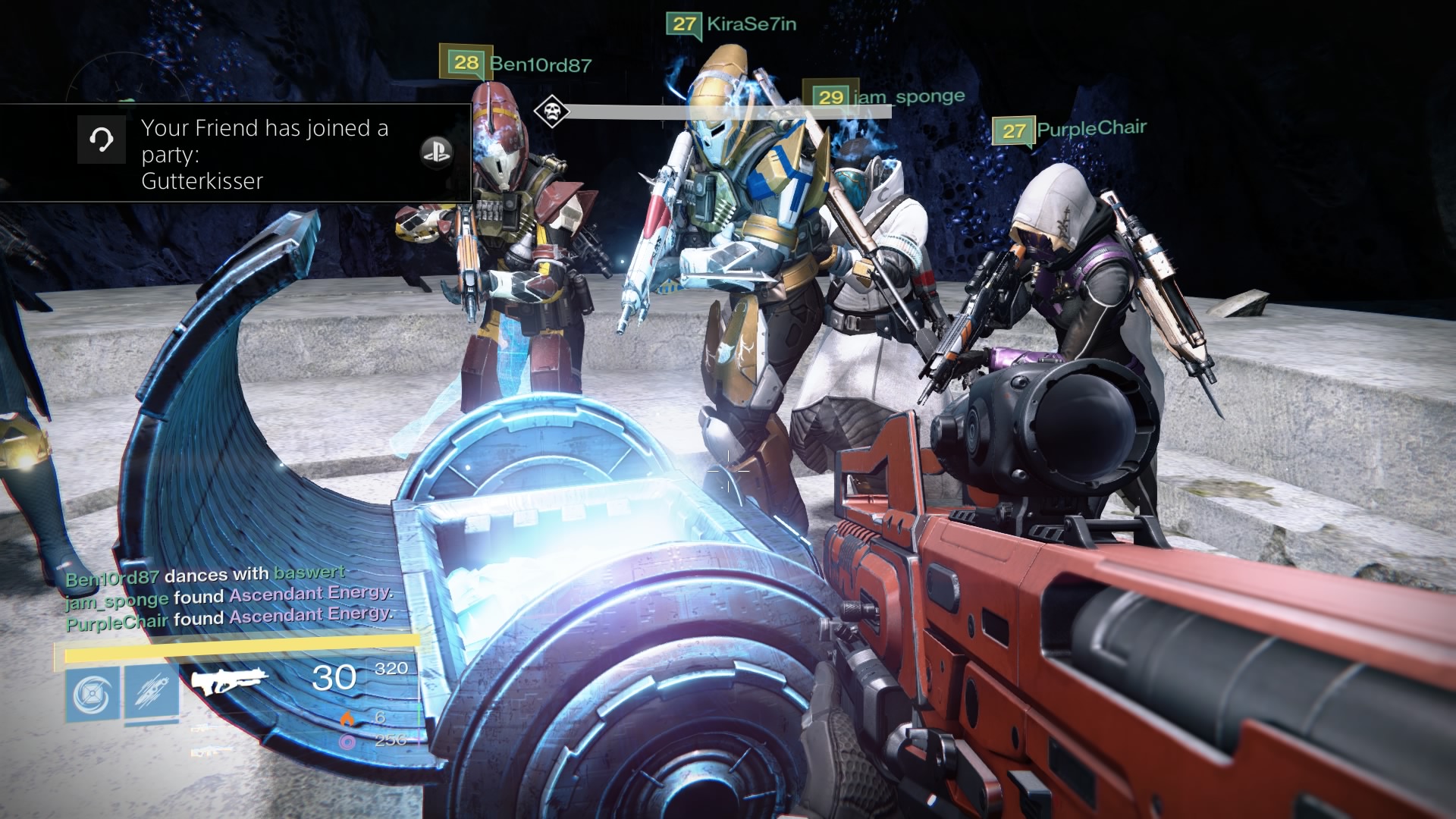
This is demonstrated perfectly through the game’s raid, The Vault of Glass, which I finally experienced for the first time last night. It was such a wonderful experience, utterly unlike anything else I’d done in the game. The challenges were different, the strategies required were different, the environment was different, the type of attention demanded of the player is different, the whole way I related to the game and other players was different.

The Vault of Glass requires you to find a team of six players (you must find the people manually; there is no random matchmaking here), and together you venture down into an entirely distinct part of the Venus map you can’t get to otherwise. A series of obscure puzzles-cum-boss-battles block your passage where you need to do very specific things (keep three parts of the map occupied at once; not be seen by this enemy type; kill that enemy type particularly fast, etc), but importantly, the game never tells you what to do at any given time. Obscure messages appear about rituals being started or whatever, but that’s it. It’s obscure the way Spelunky is obscure: overwhelming, confusing, and intimidating. This obscurity and obtuseness in mission objectives alone makes the raid stand out from the rest of the game.

In our squad of six, three of us had never done Vault of Glass before, one had done it once, and two had done it quite a few times. Very early on one of those two became an ad-hoc leader, explaining how to approach each stage. We’d have these great moments where we’d all stand or sit together on a ledge, and he’d explain what we were about to do. I can’t imagine trying to do this without such a guide. Having such a player to help us through was so rewarding, to feel like you are part of a team with a clear hierarchy like that.

The environment itself deserves applause. You start the raid on the surface of Venus, in an area you wander past all the time, and you open this safe and start venturing down and down and down into the planet. There’s gaping black chasms and narrow little crawl spaces. Vast labyrinths and heavy metal shrines. It feels distinctly like you are travelling down into some other place you have never been before. It sounds like a silly analogy probably, but it just constantly reminded me of watching The Fellowship of the Ring as the fellowship march through Moria. Our leader and more competent players would be Gandalf and Aragon at the front of the narrow path, leading us more confused little level 27 and level 28 Hobbits through the darkness.

In later challenges, half the fireteam are sent to a different place from the other three. The three that remain have to defend a pillar to keep a stargate open so the other three can go get an item, kill some things, and then return. Those on the outside tend to go radio silent and you just hear the short bursts of commands of those three who are in the other dimension. It’s such a strange feeling in a multiplayer co-op game: being so detached from what they are doing. For there to be two distinct squads, and not just more of you shooting at more of them. Maybe this would feel less distinct to anyone who has done raids in an MMO before but here, with twice as many people as a normal Destiny strike, that feeling of being part of a larger struggle was really satisfying.

Importantly, Peter Dinklage doesn’t say anything. He doesn’t ruin moments with terribly delivered exposition or obscure lure or telling you to go read something on Bungie dot com. It helped me realise just how evocative and interesting Destiny‘s world is when it doesn’t have an overlay of terrible story that makes you cringe at every noun.

The Vault of Glass felt not just unlike any other moment of Destiny, but really unique in my experience of videogames. When we finished it, three hours after we started, I was buzzing. Just absolutely buzzing. Being part of such a large team to fight our way through something so unforgiving and challenging and confronting together. That feeling that we all did it together. Now I want to go back and do it again with people who have never done it before, and pass on that knowledge I have learned. If there’s one thing Destiny has mastered, it is making you feel like you are learning, and like you could help other people learn.

Destiny_20141122004110

Website Goes Here

Hello.

I decided it was finally time to create one central place for myself on the internet, to bring together my various blogs and social media and academic work and freelance work and independent projects. Also, really, it was just time to stop using blogspot.

In the future you will probably find blog posts here, as well as links to things I write/do elsewhere on the net. In those tabs up the top are links to various things I have done or am doing, split between my academic research, independent projects, and freelance writing.